
Witnessing the Vision Come True: An Interview with Dr. Jer-Min Jian
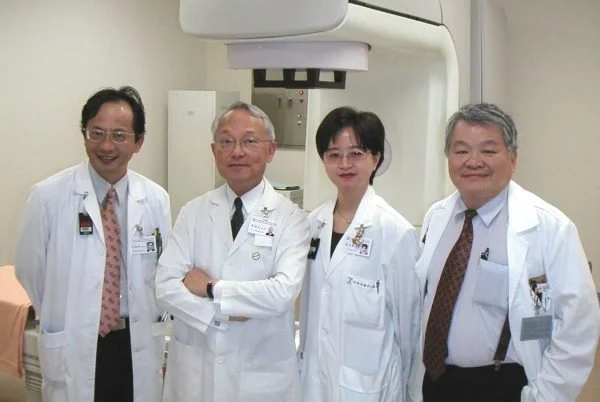
The first head of Radiation Oncology, Dr. Jer-Min Jian (right), with his successors Dr. Skye Hung-Chun Chen and Dr. Yu-Chen Tsai, together with then–Superintendent Dr. Andrew T. Huang.
I have practiced medicine for nearly fifty years, which I like to group into three chapters of roughly fifteen years each.
Chapter 1: Taipei Veterans General Hospital
My career began at Taipei Veterans General, where I trained as a resident, advanced to attending, and eventually led Radiation Oncology. Many of my patients arrived in the terminal stage—long past the window when treatment has its greatest power—and their suffering left a lasting impression.
Meeting Dr. Andrew T. Huang
In 1986 Prof. Shu-Wen Hou from Pathology told me, “Dr. Andrew T. Huang at Duke University is coming home to build a dedicated cancer hospital.” The news thrilled me. Earlier, at a conference in Malaysia on Epstein–Barr virus and nasopharyngeal carcinoma, I had met an eloquent Taiwanese physician from Duke—a chance encounter that turned out to be Dr. Huang. He shared his dream of a patient-centered cancer hospital built on true team medicine. Joining such a venture felt both an honor and a challenge.
A Year at Ren-Ai Hospital
After leaving Veterans General I signed on with the soon-to-open Sun Yat-sen Cancer Center. Dr. Pao-Huei Chen, then superintendent of Ren-Ai Hospital, asked me to spend a year there first. My task was to establish a Radiation Oncology service that would serve as a bridge to Sun Yat-sen. We carved out space—B1 for Radiology and Radiation Oncology, the eighth floor for outpatient services, Pharmacy, Pathology, and Ward 8, with half of the tenth floor for administration and Ward 10.
Recruiting for a Dream Team
I invited Dr. Kwang-Yuh Chan, who had trained in MRI in France for Veterans General, to head Diagnostic Radiology; his arrival secured the hospital’s first MRI scanner. I also reached out to Li-Hui Yu, an outstanding oncology nurse earning a master’s in the United States; she soon joined us as nursing coordinator. Step by step our core team took shape.
In 1997 Duke’s chair of Radiation Oncology visited again, spending a month with me to review and refine every aspect of our treatment process.
Chapter 2: Radiation Oncology Chair, Sun Yat-sen / KFSYSCC
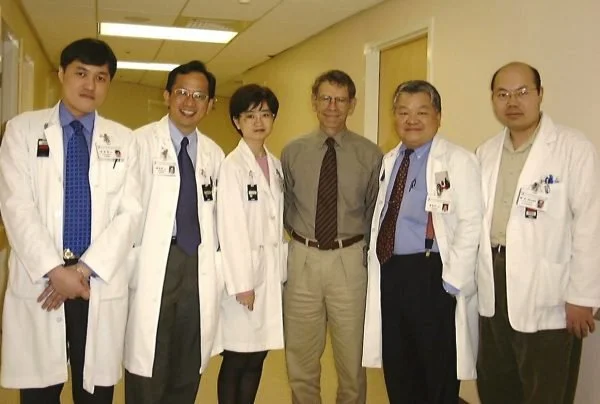
In 1997 the chair of Duke University’s Department of Radiation Oncology returned to our center and worked with Dr. Jer-Min Jian to examine every aspect of our cancer-radiotherapy workflow and operating procedures.
This phase focused on building both the temporary and permanent campuses—planning and purchasing equipment, designing safe workflows, and pushing daily throughput to sixty or seventy patients on a single machine, thanks largely to chief technologist Shu-Li Kang.
Radiation Oncology became the first department to occupy the new permanent campus in Guandu, level B2. Those early months were rough: the basement was still under construction, so staff and patients wore masks to fend off dust and used hair dryers to blow debris off the machine at night. Three months later the hospital completed its relocation to Lide Road.
To guarantee world-class quality, Dr. Andrew T. Huang invited Duke’s chair, section chiefs, physicists, and dosimetrists to audit our program for a month. Their endorsement confirmed that our safety culture met international benchmarks.
Dr. Huang trusted each specialist to choose equipment wisely. His only directive: plan thoroughly, verify every specification, and aim for multifunctional utility—price comes second. That philosophy still guides procurement today.
Chapter 3: Chief Medical Officer
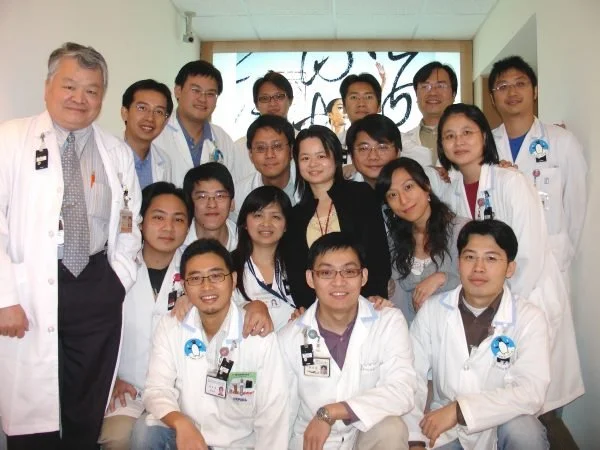
A year earlier, in 1996, Dr. Jer-Min Jian gathered with the department’s radiation therapists for a commemorative photograph.
Dr. Huang next appointed me Chief Medical Officer. Leading physicians is delicate; each doctor holds strong opinions. During annual reviews some disputed their performance ratings. I spent time understanding their concerns, deciding whether adjustments were warranted, and closing every cycle without unresolved issues.
Under Dr. Wen-Ling Peng’s coordination, I helped the hospital secure multiple rounds of Joint Commission International accreditation, ensuring our safety and quality matched global standards.
Driving Digital Transformation
When IT launched electronic health records, I volunteered as the first tester and found the interface intuitive. All Radiation Oncology physicians migrated within a week. The same happened when we replaced tape dictation with digital recording.
Integrating Services
We still have room to streamline cross-department processes. A sarcoma patient treated with us for seventeen years once asked why he had to pull separate numbers for billing, pharmacy, and imaging. I encouraged him to drop a note in our suggestion box so the right teams could act on his idea for one-stop service.
Current Role: Consulting Physician
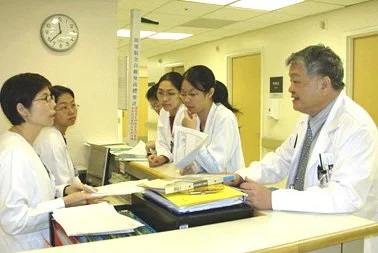
Since stepping down as CMO in 2022 I have returned to Radiation Oncology as a consultant. KFSYSCC is a family defined by trust and innovation, and I will keep contributing as long as I can. On Lide Road I have watched Dr. Andrew T. Huang’s team-based vision become daily reality. Multidisciplinary boards craft personalized plans for nasopharyngeal, colorectal, and breast cancers, boosting outcomes and cutting side effects.
Dr. Huang also holds fast to one rule: no physician is paid by the number of patients seen. Linking income directly to volume would shorten visits and harm care. From day one he has protected that principle.
He invests heavily in young doctors, sending many abroad. Dr. Yu-Chen Tsai, now our Radiation Oncology Chair, spent a year at Duke. Alumni spread across Taiwan, carrying KFSYSCC’s culture wherever they go.
On the hospital’s thirty-fifth anniversary I can say with conviction: KFSYSCC is a place free of ego, rich in trust, and alive with ideas. Dr. Andrew T. Huang stands behind us, unobtrusive yet supportive, imposing no limits. I urge every colleague to nurture confidence, keep learning, and carve out a unique career path.