
Relieving Pain Is Medicine’s First Task, Not an Add-On: Patient-Controlled Analgesia Explained
Interview with Prof. Andrew T. Huang and Dr. Wen-Ling Peng · Edited by Joanna Lin
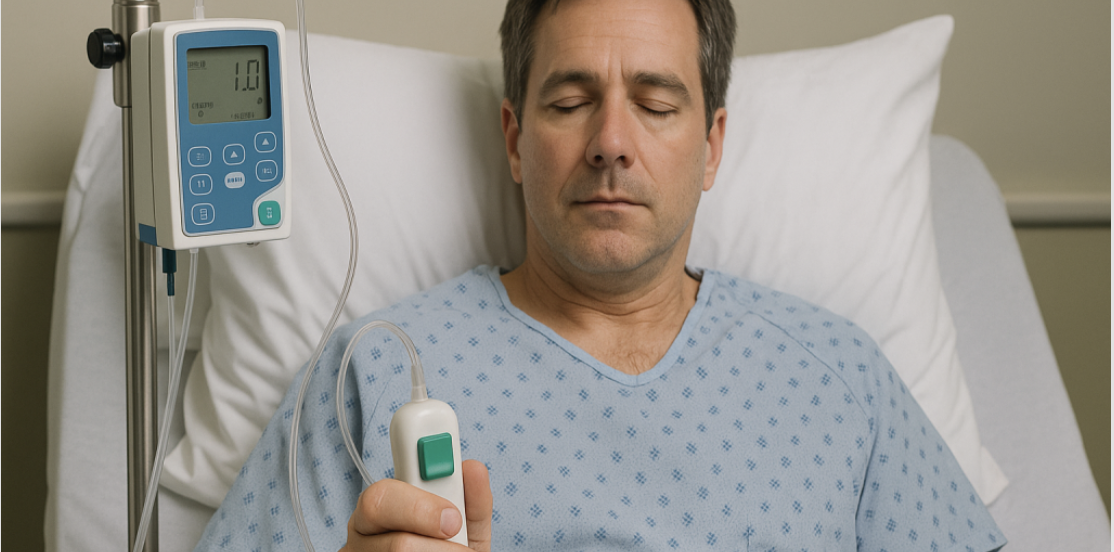
Cancer pain wears many faces. Every patient feels it differently, and even the same patient may describe pain that shifts from hour to hour. Tumors press on nerves, trigger inflammation, block blood flow, obstruct organs, or invade bone and cause fractures. Surgery, inactivity, and drug side effects—nausea, constipation, mouth ulcers—add further layers of discomfort. The result is not just physical agony but emotional weight: frustration, tension, and anxiety.
Care That Puts Patients First
“Treat the disease, but also ease the patient’s body and mind.” Prof. Andrew T. Huang set this principle when Koo Foundation Sun Yat-Sen Cancer Center opened, and the team still follows it. They scan the global medical landscape for ideas that lighten a patient’s burden, then adapt those advances to Taiwan’s needs. One standout example is the Patient-Controlled Analgesia (PCA) pump. Prof. Huang recalls, “When I worked in the United States more than thirty years ago, PCA was common. Taiwan had none.” Recognizing pain’s grip on quality of life, the hospital adopted Abbott’s PCA system the day it opened in 1990, bringing timely relief to every cancer patient who needed it.
What Is a PCA Pump?
A PCA unit is a programmable device filled with pain medication before surgery. After the operation it connects to the patient’s IV line. Whenever pain flares, the patient presses a button and receives a preset dose. Because opioid dosing must be precise, physicians program strict limits: for example, one milligram per press, at least five minutes between doses, and no more than ten milligrams over four hours. The pump enforces these ceilings automatically, safeguarding against overdose.
Returning Control to Patients
Pain is a lonely experience, defined only by the person who feels it: location, onset, stabbing or throbbing, mild or fierce. No scan can fully capture those details. PCA restores agency, letting patients match relief to real-time need and narrowing the gap between their words and the nurse’s interpretations.
Before minimally invasive surgery became routine, large incisions in the chest, abdomen, pelvis, or joints caused severe postoperative pain that kept patients from breathing deeply, turning, or getting out of bed. From its first day the hospital paired general anesthesia with epidural regional blocks, reducing anesthetic requirements and letting many patients wake with little or no pain. For the next five days an epidural catheter delivers low-dose local anesthetic and opioid via a PCA pump. Patients can breathe, move, and rehabilitate earlier, cutting complications and speeding recovery. Surgeons rely on PCA because it improves sleep, shortens hospital stays, and eases the strain on caregivers.
Comfort at Home for Cancer Patients
More than thirty years ago KFSYSCC began sending PCA pumps home with Taipei-area patients—at the time a national first. Home-care nurses visit to transfuse blood, administer drugs, handle pain control, and teach families how to change batteries or restart the device. Pharmacists repackage small vials, each holding only 10 or 20 milligrams, into larger bags that hold several days’ supply. Prof. Huang notes, “Bone metastases cause agony so sharp patients cannot even roll over. With a PCA they dare to move, lowering pneumonia risk and slowing muscle and bone loss. Each comfortable moment is priceless, especially in the final stage.”
A Team Committed to Every Detail
Whether delivering drugs intravenously or into the epidural space, the pharmacy compounds every dose in a sterile suite, keeping infection control at the highest standard—a practice the hospital adopted nearly two decades ahead of most local institutions. Surgeons, anesthesiologists, nurses, and pharmacists willingly invest extra time and effort because their goal is more than treating cancer; it is standing beside patients through every step of the fight.
Quick Facts: Patient-Controlled Analgesia
Full Name: PCA (Patient Controlled Analgesia)
Purpose: Allows patients to self-administer pain medicine safely and on demand
Common Drugs: Opioids such as morphine or fentanyl
Typical Users: Post-operative patients, cancer pain cases, chronic pain sufferers
Operation: Patient presses a button; the pump delivers a set dose
Safety: Physicians program dose limits, time intervals, and maximum totals
Benefits: Faster recovery, lower caregiver burden, reduced delays in pain relief