
Resilient as Light: Ms. Hu’s Cancer Journey
By: Su-Mei Chang, Center for Technology and Humanities
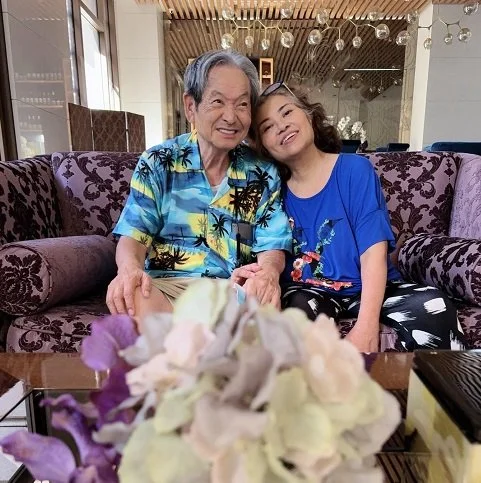
Ms. Hu’s life reads like a long novel with dramatic highs and lows. She knew poverty in childhood, the strain of fighting for a future far from home, and later, the applause and glamour that came at the peak of her career. No one expected that this strong woman, who always faced the world with a smile, would one day have her life’s rhythm completely rewritten by a sudden illness.
Strength in Childhood: Growing Power Out of Hardship
“When I was little, my parents had to go up into the mountains to work. I was the second child, and there were four younger siblings who needed care, so I had to grow up early.” Ms. Hu remembers her childhood with a calm voice that still carries resolve.
Her father was Rukai and her mother was Paiwan, and she grew up in Taitung in the 1950s in a household with very limited means. Being able to stay in school felt like a luxury. She had to stop attending school in second grade because she needed to care for her siblings, but her teacher could not bear to see her give up. The teacher often encouraged her to run in school races and even helped keep her enrollment active, so she could eventually receive her elementary school diploma.
“I joined races for a simple reason: there were steamed buns to eat, and clothes to wear,” she said honestly. But perhaps that was when she learned something that stayed with her for life: even in the hardest seasons, if you keep running with everything you have and keep living with intention, you can still find light.
Starting From Zero: Leaving Home and Fighting for a Future
At the age of fourteen, Ms. Hu left her hometown to help support her family and went alone to work in a textile factory in Tainan. She was young, but she already understood responsibility. “I actually liked it when people took leave, because then I could cover their shift and earn more,” she laughed, sounding practical beyond her years.
Later, she moved north on her own and helped at a restaurant business run by her brother-in-law. Because many customers were Japanese, she taught herself Japanese little by little.
When she was 23, her father passed away, and the family suddenly lost its main financial support. Her youngest sister was only nine, and her oldest sister was already married. As the family struggled with household expenses and debt, a cousin in Japan asked Ms. Hu to come help because she was overwhelmed with childcare. Ms. Hu went abroad and started as an assistant, learning how to operate a Japanese “club,” a type of evening venue that combines dining, hospitality, and social entertainment.
Over the next few years, through hard work and sincerity, she built a stable base of customers. At 30, she decided to open her own business. “I thought, if I’m running things this well, why not do it myself?” Once she became independent, her business grew quickly. She opened an izakaya as well and later established a branch in Taiwan.
During those years, after closing the shop in the early morning, she still had to handle accounting and purchasing, and she often traveled back and forth between Taiwan and Japan. It was exhausting, but it brought a deep sense of accomplishment. “Back then, I wasn’t afraid of anything,” she said. Determined to give her siblings a stable life, she pushed herself like “a little steel worker,” never stopping, always moving forward.
The Turn in Fate: Symptoms, Delay, and Diagnosis
After years of night shifts and heavy pressure, Ms. Hu began experiencing blood in her urine and abdominal pain in November two years ago. At first, she assumed it was related to uterine fibroids and visited an OB-GYN clinic. The doctor recommended further internal medicine evaluation. After that, she eventually made her way to urology, where the cause was finally identified.
“When the doctor told me it was Stage III kidney cancer, and that they might have to remove my right kidney and ureter, and that I might need dialysis for the rest of my life, I felt completely numb,” she recalled. “All I could think was: I can’t accept being on dialysis forever.” At that time, she still had not fully grasped how serious it was. Even after the diagnosis, she and her husband traveled abroad, trying to act as if nothing had happened.
The Cost of False Hope: A Detour Into “Alternative” Treatment
Her condition continued to worsen. Because she desperately wanted to avoid dialysis, she returned to Taiwan and tried a treatment advertised as effective by a certain clinic. Each session cost more than NT$100,000, but instead of improving, she grew weaker. “I was passing so much blood every day,” she said. Eventually, she became so severely anemic that she could not even stand. “I was really foolish. When you’re sick, you’ll try anything. I watched a famous doctor on YouTube and thought I should give it a chance,” she said with regret.
One time, the abdominal pain became unbearable and she was rushed to the emergency department at Mackay Memorial Hospital. But before a full evaluation could be scheduled at the large hospital, she returned to the clinic. It was then that a nurse quietly told her, “With your condition, you really should go to KFSYSCC. They specialize in cancer care, and they’ll take good care of you.”
That single sentence led Ms. Hu to KFSYSCC and became a turning point in her life.
At KFSYSCC: Feeling Cared For Again
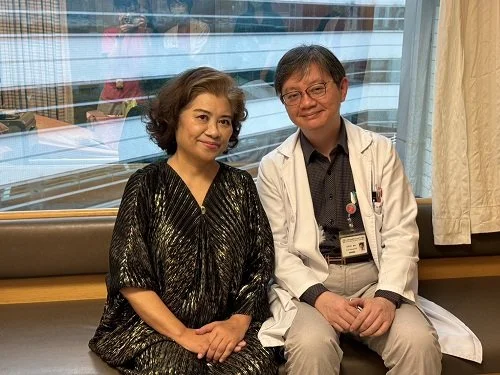
After arriving, Ms. Hu visited the urology clinic of Dr. Chih-Kuei Hsu. After reviewing her condition, Dr. Hsu decided to collect a tissue sample personally. During the evaluation, the team unexpectedly found abnormal enlargement of lymph nodes on both sides, and she needed emergency surgery right away.
Ms. Hu recalled that although she was not fully clear-headed at the time, she could still hear what was happening around her. She remembered Dr. Hsu urgently directing the team to prepare equipment, to the point that a nurse briefly assumed she might be related to him because of how determined he sounded. In that life-or-death moment, she felt an unexpected wave of relief: “I finally came to the right hospital.”
After detailed diagnostic work, the final diagnosis was urothelial carcinoma. Because KFSYSCC operates with a multidisciplinary team model, her care was transitioned to medical oncologist Dr. Kuo-Cheng Huang, and she began a comprehensive treatment course that included immunotherapy, targeted therapy, and chemotherapy.
A Narrow Escape: Brain Metastasis and a Major Surgery
This September, an unexpected fever raised Dr. Huang’s concern that something had changed. Tests confirmed that Ms. Hu had developed brain metastasis. When urothelial carcinoma progresses to Stage IV, cancer cells may spread to distant organs such as the lungs, bones, or brain.
Neurosurgeon Dr. Ih-Hsin Chen took over immediately and arranged surgical removal. At that time, the brain tumor was causing pressure that left Ms. Hu’s left hand and leg almost unable to move.
“I still remember that before surgery, Dr. Chen came to my room and told me, ‘I’ll try to keep your incision as small as possible, but if something happens during surgery, is it okay if I need to make it bigger?’” Ms. Hu laughed as she recalled it. “I thought, what kind of doctor asks the patient ahead of time like that? I told him, ‘I trust you. I’m leaving everything to you.’”
Dr. Chen also told her honestly that he could not guarantee whether movement on her left side would fully return. Fortunately, the surgery was successful, and with follow-up chemotherapy, Ms. Hu can now gradually lift her left arm again.
From Illness to Gratitude: Redefining What It Means to Live
Perhaps because of the natural optimism she attributes to her Indigenous roots, Ms. Hu continues to face pain with a positive mindset. “When my hand couldn’t move, my husband told me, you’ve worked too hard, so God is making you rest a little.” In the hospital ward, she would even sing and dance for the staff, refusing to see herself only as a patient.
During treatment, she faced multiple life-threatening moments, including a sudden pulmonary embolism after surgery, but she made it through. She joked, “The doctors said I must have done a lot of good things.” In fact, she has long supported her community through action. Many of her tribal members live in Jinfeng Township, which was hit hard after Typhoon Morakot (the ‘88 Flood’). To help, she donated land for housing, supported levee construction, and even provided financial help for families rebuilding their homes.
“Before, I only knew how to push myself to make money. Now I understand how important it is to care for my health,” she said. She shared that KFSYSCC gave her more than medical treatment. It gave her courage and hope. “I truly feel that KFSYSCC is not just a hospital. It’s a place where people can see hope again.”
Through this interview, Ms. Hu expressed heartfelt thanks to KFSYSCC and the medical team that has cared for her so attentively. From patient explanations before surgery, to careful follow-up afterward, to the encouragement and companionship offered in the hardest moments, she felt the team’s dedication and warmth. She knows there may be more challenges ahead, but she believes that with KFSYSCC’s support, she can face each one with courage.