
Treatment Recommendations for Patients With Stage IV Breast Cancer
Reviewed and edited by: Dr. Ben-Long Yu (Department of Surgery)
Compiled by: Su-Mei Chang (Center for Humanities and Technology)
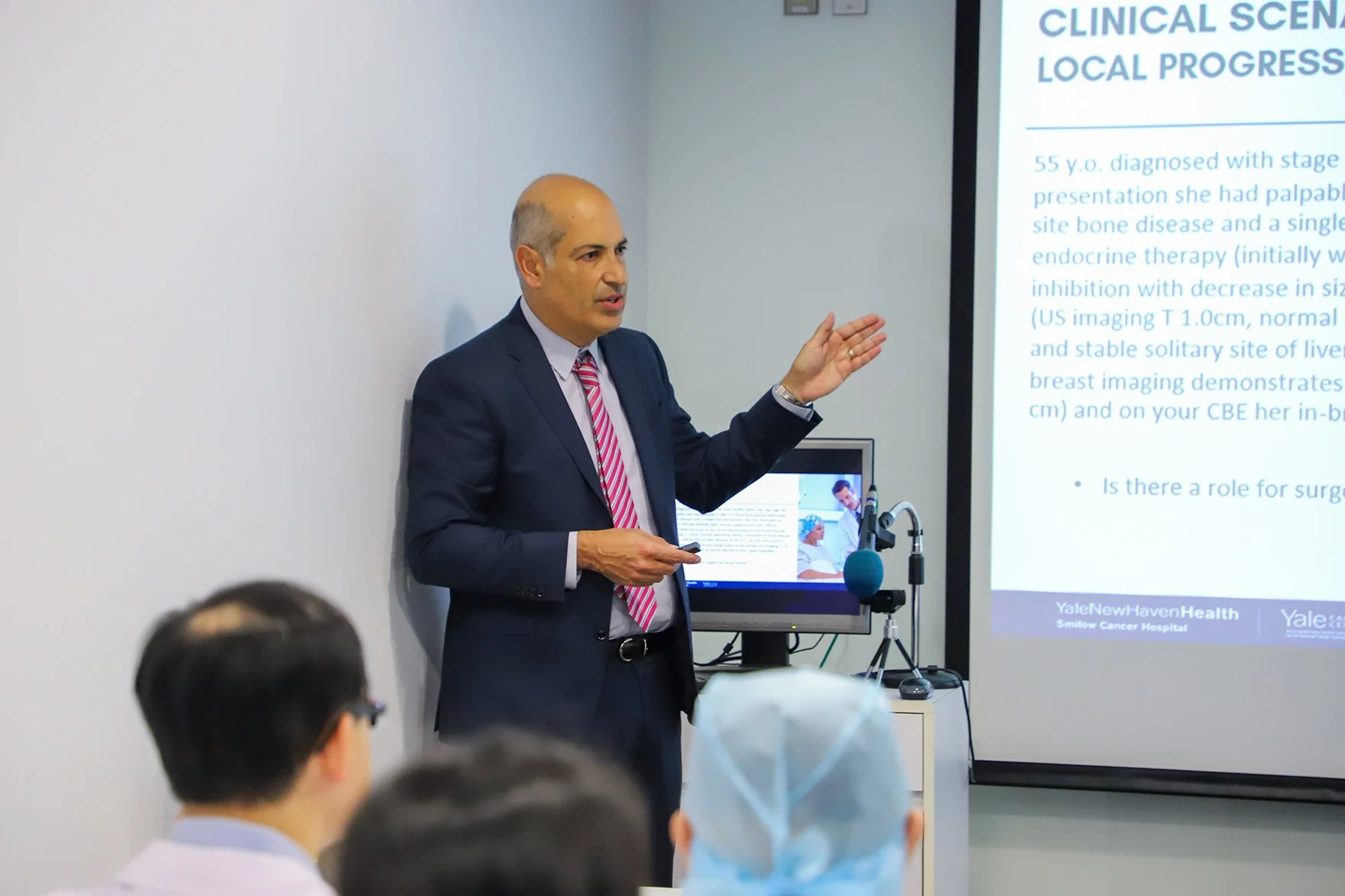
On October 24, 2025, our hospital welcomed Dr. Mehra Golshan from the Yale School of Medicine during his visit to Taiwan. Dr. Golshan is a Professor of Surgical Oncology at Yale and Clinical Director for Breast Cancer, and he has led multiple international clinical trials focused on advancing personalized surgical strategies and innovative preoperative (neoadjuvant) treatment approaches in breast cancer. During his visit, he delivered a lecture titled “Treatment Recommendations for Patients With Stage IV Breast Cancer.” What follows is a clear summary of the key points.
A Shift in Thinking: From “Not Recommended” to “Worth Testing”
Before 2002, the standard framework was relatively straightforward. For early-stage breast cancer (Stage 0 through Stage III), local control (treating the tumor in the breast and nearby lymph nodes) was considered important and linked to overall survival. For Stage IV breast cancer, where the cancer has spread to distant sites (metastatic disease), the prevailing belief was that local treatment of the breast tumor did not improve survival. Surgery was generally reserved for symptom relief, such as controlling bleeding, pain, or ulceration. At the time, this view was widely treated as settled medical doctrine.
That certainty began to change after a landmark analysis published in 2002 by Dr. Seema A. Khan and colleagues. Using the U.S. National Cancer Database, the team analyzed 16,023 patients with Stage IV breast cancer diagnosed between 1990 and 1993. They found that 57.2% of these patients underwent surgery. Survival appeared longer among those who had surgery than among those who did not. Median survival was 19.3 months for patients who did not have surgery, 26.9 months for those who had partial mastectomy (breast-conserving surgery), and 31.9 months for those who had mastectomy.
This study was like a stone dropped into calm water. It triggered many follow-up population studies. Across analyses totaling more than 65,000 patients, results often looked similar on the surface: patients who underwent surgery seemed to live longer. Understandably, this created renewed hope that surgery might matter even in metastatic disease.
The Problem Behind the Pattern: Selection Bias
Criticism came quickly, and it focused on a fundamental issue: selection bias. In real-world observational datasets, the people who get surgery are often different from the people who do not. When researchers looked closely, the surgical groups tended to have better baseline prognostic factors. They were often younger, had fewer metastatic sites, were more likely to have bone-only metastasis, and were more likely to have hormone receptor-positive disease. In other words, these patients may have been expected to live longer regardless of surgery. In that case, surgery might simply be a marker of “better-risk” disease rather than the cause of longer survival.
To address this, researchers started using more rigorous methods to reduce bias. In 2009, Bafford and colleagues reported an analysis of 147 patients, 61 of whom underwent surgery. They pointed out a striking difference that highlighted selection effects: patients who were known to have Stage IV disease before surgery had a survival of 2.4 years, while patients thought to have early-stage disease at the time of surgery but later found to have Stage IV disease had a survival of 4.05 years. The gap strongly suggested that who gets selected for surgery can heavily influence survival results.
In 2011, Dominici, Najita, and colleagues analyzed the NCCN database using a more rigorous matching approach. They matched 54 patients who received surgery followed by systemic therapy with 236 patients who received systemic therapy alone, carefully matching factors such as age, number of metastatic sites, hormone receptor status, and HER2 status. The result was sobering: survival was 3.5 years in the surgery group and 3.4 years in the non-surgery group, essentially no difference. Their conclusion was that earlier “survival advantages” seen in observational studies likely reflected clinical selection rather than a true benefit of surgery.
Randomized Trials: The Strongest Answer
With conflicting evidence, the field reached a clear conclusion: only prospective randomized controlled trials could answer this question reliably. Multiple randomized trials were launched worldwide, including efforts in India, Turkey, Denmark, the United States, Japan, and Austria.
The most persuasive evidence highlighted in the talk came from the ECOG-ACRIN E2108 trial (also referenced as EA2108), a multicenter randomized study that began enrolling patients in 2011 and ultimately randomized 258 patients.
The design was intentionally strict. All participants first received 4 to 8 months of optimal systemic therapy (drug treatment). Only patients whose distant metastatic disease did not progress during this initial period were eligible for randomization. Patients were then assigned to one of two strategies. One group received early local therapy: complete surgical removal of the primary breast tumor with negative margins, followed by postoperative radiation therapy according to standard care. The other group continued with systemic therapy alone (continued systemic therapy, CST).
After a median follow-up of 53 months, median overall survival was 53.1 months in the systemic-therapy-only group and 54.9 months in the early-local-therapy group, with no statistically significant difference. The key message was clear: even among Stage IV patients who respond well to systemic therapy, adding early surgery and radiation to treat the breast tumor does not improve survival.
Subgroup Findings That Clinicians Should Notice
Deeper analysis revealed important details by breast cancer subtype. At the 2020 ASCO meeting, Dr. Khan reported that survival did not differ meaningfully based on whether early local therapy was performed in patients with HER2-positive disease (79 patients; HR = 1.05) or those with hormone receptor-positive, HER2-negative disease (137 patients; HR = 0.94). However, among the triple-negative breast cancer subgroup (only 20 patients), survival appeared worse in the early-local-therapy group (HR = 3.50). While this subgroup was small and should be interpreted cautiously, it raises a clinically important concern: for triple-negative disease, early surgery may be not only unhelpful but potentially harmful in some situations.
How Clinical Practice Has Changed
These findings have influenced real-world care. Data from 2004 to 2017 show that the proportion of Stage IV breast cancer patients undergoing surgery peaked around 2013 and then began to decline. This timing aligns with the period when E2108 enrollment was underway and when the role of surgery was increasingly questioned. By 2017, surgical rates had decreased across tumor subtypes, suggesting that clinicians were integrating emerging evidence into decision-making.
The data also show that Stage IV patients who receive palliative care are less likely to undergo surgery or radiation. This reflects a broader shift toward individualized planning that weighs overall health, expected prognosis, and, most importantly, the patient’s goals of care.
Practical Clinical Recommendations and the Direction Ahead
Based on high-quality randomized trial evidence, a clearer approach is now recommended. For Stage IV breast cancer, surgery to remove the primary breast tumor should not be routine. Systemic therapy should be the primary strategy, since metastatic disease is fundamentally a whole-body illness.
Surgery should be reserved for situations where local treatment is needed for symptom relief or local control that cannot be achieved well by other means, such as when the breast tumor causes significant pain, bleeding, ulceration, or other difficult local complications.
Even when surgery can improve local control, randomized trials indicate that it does not improve overall survival. This should be communicated honestly during shared decision-making. If a patient experiences severe anxiety about leaving the primary tumor in place and still strongly prefers surgery after understanding the risks and expected benefits, that preference should be respected as part of individualized care.
At the same time, the outlook for Stage IV breast cancer has improved meaningfully in recent years, driven by ongoing advances in systemic therapies, including targeted agents and immunotherapy. These treatments have expanded options and improved survival opportunities for many patients.
A memorable framework shared in the talk uses a metaphor: tumor biology is like the king, setting the direction of the disease; the patient’s choices and overall treatment strategy are like the queen, strongly shaping outcomes; and technical procedures such as surgery or radiation are like princes and princesses. They can sometimes appear to “win” in the short term, but they rarely change the long-term trajectory unless the underlying biology and strategy are addressed. This idea echoes a well-known surgical oncology principle: without mastering tumor biology and an appropriate overall strategy, even the most sophisticated technical interventions cannot overcome the fundamental nature of the disease.
References
Khan, S. A., Stewart, A. K., & Morrow, M. (2002). Does aggressive local therapy improve survival in metastatic breast cancer? Surgery, 132(4), 620–626. https://doi.org/10.1067/msy.2002.127544
Dominici, L. S., Najita, J., Hughes, M., et al. (2011). Surgery of the primary tumor does not improve survival in stage IV breast cancer. Breast Cancer Research and Treatment, 129(2), 459–465. https://doi.org/10.1007/s10549-011-1648-2
Khan, S. A., Zhao, F., Goldstein, L. J., et al. (2022). Early local therapy for the primary site in de novo stage IV breast cancer: Results of a randomized clinical trial (EA2108). Journal of Clinical Oncology, 40(9), 978–987. https://doi.org/10.1200/JCO.21.02006
ASCO Post conference highlight summary (ASCO 2020):
https://ascopost.com/issues/july-10-2020-supplement-conference-highlights-asco20-virtual-scientific-program/no-survival-benefit-from-local-therapy-in-de-novo-metastatic-breast-cancer-study/