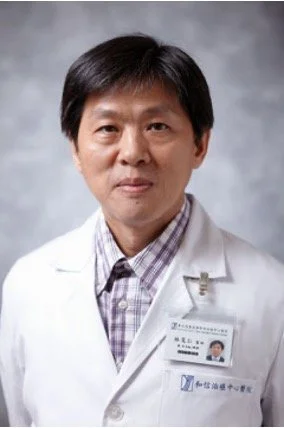
Author: Breast Cancer Multidisciplinary Team, Dr. Christopher K.J. Lin
Dr. Lin, currently serving as the Head of the Radiology Department and Attending Physician of Radiology at the Koo Foundation Sun Yat-Sen Cancer Center, specializes in oncologic radiology, interventional ultrasonography, general ultrasonography, and diagnosis of various breast diseases. He is proficient in a variety of ultrasonographic techniques, stereotactic localization, magnetic resonance imaging, as well as guiding breast core biopsies and vacuum-assisted biopsies.
Dr. Lin obtained his Medical Degree from the National Defense Medical Center. He began his career as an attending physician in the Radiology Department of Taipei Veterans General Hospital in 1990. In 1993, he served as an attending physician in the Radiology Departments of Taipei Veterans General Hospital's Yuli and Taoyuan branches. He joined KFSYSCCin 1995 and has been serving here ever since. He is also a part of the hospital's multidisciplinary breast cancer treatment team.
My Experience with Breast Imaging
A few years back, KFSYSCC was recognized in the media as having the top breast cancer diagnostic facility in Taiwan. Approximately one in ten Taiwanese breast cancer patients sought surgical treatment at KFSYSCC, earning us the highest volume of breast cancer surgeries performed in Taiwan over several years. However, KFSYSCC is merely a specialized cancer institution with a capacity of around 200 beds, a small entity compared to the multitude of larger hospitals and medical centers throughout Taiwan. Yet, we attained this notable status due to our continuous diligent efforts.
KFSYSCC, now nearing its 30th anniversary, was initially located in two leased floors of Taipei City Renai Hospital before establishing our permanent center in Guandu. The hospital director at that time assembled an esteemed team: Dr. Chen Qiming, a prominent Northern Taiwanese surgeon known for his proficiency in breast cancer surgeries, was appointed as the Head of Surgery. Dr. Lin Shuxin, formerly a Pathology Director in the United States, was invited to return to Taiwan to assume the role of Pathology Director. We also recruited Dr. Zhou Yihong, a respected ultrasound specialist, on a part-time basis. Through these collective steps, we constructed a highly-regarded breast cancer diagnosis and treatment team. It is fair to state that breast cancer treatment was KFSYSCC’s largest and most significant department from its inception, reflecting our substantial dedication in manpower, resources, and commitment.
The following section details how we progressively realized this achievement:
Equipment
Dr. Zhan Guangyu, the Director of Radiology at that time, purchased the first mammography machine in Taiwan, heralding the onset of X-ray-based screening and diagnosis of breast diseases in the country. As per evidence-based studies, mammography has emerged as the only effective tool worldwide for conducting large-scale breast screenings and has significantly lowered the mortality rate of breast cancer. I joined the Radiology department in 1995, during the fifth year of KFSYSCC’s existence. My knowledge of mammography evolved from complete ignorance to a level where it is now an integral part of my daily work routine.
After countless days, nights, and years of intense training and learning, I have become a regular speaker and mentor on breast health at the Breast Medical Association, Radiology Society, and Ultrasound Medical Association. The images produced by mammography carry a certain bittersweet quality.
In the early days of mammography, the machines used to generate X-ray films required film processing, making it one of the most intricate diagnostic tools within the radiology field. Given the considerable data it produced, it was the last among the X-ray examination methodologies in the Radiology Department to transition to digital.
My understanding of mammographic images was initially limited. Fortunately, Dr. Shi Tingfang, who at the time was employed part-time in the Radiology Department of National Taiwan University (and who has since served as the department head), provided invaluable mentorship in mammography.
As technology advanced, it was natural for X-ray imaging to digitize fully. Our hospital was one of the early adopters, purchasing its first fully digital mammography machine in 2005. This decision was driven by evidence showing that the digital machine enhanced breast cancer detection in dense breasts compared to traditional film-based mammography. However, numerous breast cancers, which manifest as soft tissue masses, remained undiagnosed when they were of small volume.
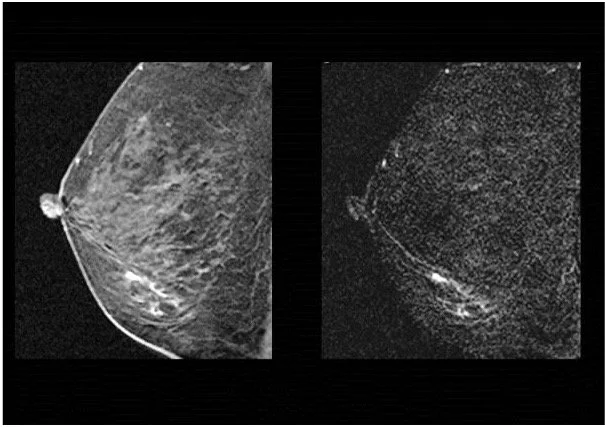
Just a few years ago, the development of 'breast tomography scanners' began to uncover the veiling effect of dense breasts. These devices are now gradually being adopted in larger medical centers throughout Taiwan. They can employ contrast agents to reach a high level of sensitivity and specificity comparable to breast Magnetic Resonance Imaging (MRI), thus identifying breast cancers that may be invisible to breast ultrasound or digital mammography. This year, we intend to acquire the newest model of this scanner to boost the detection rate of early-stage breast cancer, a move that will greatly benefit our patients.
When discussing breast diagnosis, it's crucial to use image-guided interventions, such as ultrasound, mammography, MRI-guided core needle biopsy, and vacuum-assisted biopsy (VAB). As one examines the evolution of breast diagnosis in major global medical centers, a common trend emerges: the more prestigious the center, the stronger its capabilities in interventional diagnosis, with surgeries becoming increasingly less invasive. In some cases, benign lesions can be eliminated via needle aspiration, eliminating the need for surgery altogether.
Every year, I participate in international breast cancer diagnostic conferences. From early on, I recognized that core needle biopsy was destined to become a standard procedure in diagnosing breast diseases. Therefore, before it became commonplace in Taiwan, I integrated it into our hospital's standard protocol for diagnosing breast cancer. Over the years, I have been invited to present this procedure at the Radiology Society, Ultrasound Medical Association, and Breast Medical Association in Taiwan. Today, it has been established as a standard methodology for diagnosing breast cancer within Taiwan.
In 2000, I was given the opportunity to travel to Canada and delve into the application of core needle biopsy for mammographic breast calcification sampling. The traditional approach, requiring invasive surgical procedures in a hospital setting to ascertain the benign or malignant nature of breast calcifications, carried significant risk, particularly as 70-80% of these operations revealed benign calcifications. The advent of stereotactic core needle biopsy for outpatient calcification sampling transformed this practice. With a skin puncture no larger than a mosquito bite, we can establish the nature of the calcifications and decide on further treatment or monitoring, reducing the need for surgical intervention. In cases where breast cancer is diagnosed via biopsy, it facilitates the development of more informed preoperative plans, reducing the likelihood of secondary surgery.
However, core needle biopsies are not without limitations. For instance, extremely small calcifications representing early-stage breast cancer may occasionally be overlooked, leading to some false negatives. In response to this, the vacuum-assisted biopsy (VAB), which uses a larger needle with suction capabilities, was developed in the late 1990s. Guided by ultrasound, mammography, and MRI, VAB allows the removal of most of the suspicious lesion or lump, thus drastically reducing the risk of false negatives. If the lesion is benign, there's no need for further surgical intervention, aligning with the modern medical principle of "minimal invasiveness."
Our institution, KFSYSCC, is among the few in Taiwan that adopted vacuum-assisted biopsy for breast calcification sampling early on. Having honed our skills with stereotactic core needle biopsy, we could optimize the use of this new technology. Subsequently, Taiwan introduced a more efficient VAB model. KFSYSCC was the first hospital in Taiwan to use this device for breast calcification biopsies, and I was the first physician to operate it. With this history, KFSYSCC now boasts the highest patient volume and the most experience with vacuum-assisted biopsy for breast calcifications in Northern Taiwan. With minimal scarring and accurate diagnoses, our patient satisfaction rate is extremely high.
The use of MRI has been beneficial in detecting lesions that can only be identified with this modality. However, the likelihood of identifying benign lesions far outweighs that of malignancies. Adhering to the "First, do no harm" principle, our surgical team prefers to employ vacuum-assisted biopsies to confirm a lesion's benign nature, thus avoiding unnecessary surgery. If a malignancy is detected, we can then devise a more robust preoperative plan. Consequently, most of our interventions employ MRI-guided vacuum-assisted biopsies, giving us an unrivaled level of experience and a high case count in Northern Taiwan.
2. Personnel
In the intimate setting of KFSYSCC, the Surgery, Pathology, and Radiology departments collaborate seamlessly. Starting with early fine-needle aspiration, immediate cytological examination and validation are performed, thus improving our precision in ultrasound interpretation. Our facility's ability to discern potential diagnoses or differential diagnoses based on various imaging modalities has been finely honed. The willingness of many patients to receive treatment here has enabled us to gather a wealth of valuable imaging data. By continuously revisiting original cancer diagnoses when reviewing images, we accumulate experience and continually refine our skills. As our patient volume has grown since relocating to our permanent Guandu center, so too has our team of radiologists, enabling us to handle larger caseloads. Our standard operating procedures and commitment to continuous improvement represent our strengths.
Machine operation and maintenance, image quality control, and the role of radiologic technologists are essential. Our Radiology Department routinely reviews and analyzes problematic imaging diagnoses to prevent others from repeating the same mistakes. Despite radiologic technologists not being physicians, we educate them as if they were, firmly believing that they can only perform optimally when armed with medical knowledge. Consequently, our doctors share the content of their external lecture presentations with our technologists, constantly enhancing their foundational professional abilities and work quality.
In the Radiology Department, our nurses play an integral role in a high volume of interventional procedures. Our nursing staff, larger than many medical centers, are responsible for patient education, physiological monitoring, and pre- and post-biopsy care, adhering closely to established protocols. Amidst the rigorous demands of biopsy procedures, we deeply appreciate their contributions. Their dedication substantially alleviates patient anxiety and the potential risks associated with biopsies.
Conclusion
Our success today is a testament to our longstanding dedication and collective team effort. We exist for our patients, taking great pride in delivering high-quality, precise mammography services. Our aim is to enable our patients to live boldly and joyfully, free from the anxieties and threats posed by cancer. I am deeply proud of our team and am thankful for their hard work. I consider the patients we have served as fortunate individuals and wish everyone a healthy, happy life.