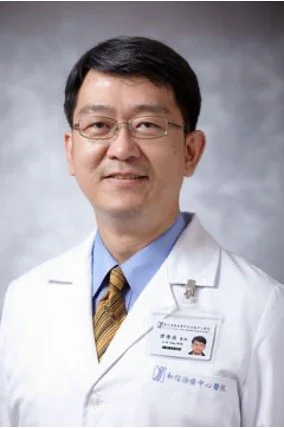
Author: Hematopoietic Stem Cell Transplantation Multidisciplinary Team, Dr. Tran-Der Tan
Dr. Tran-Der Tan currently serves as the deputy director of the Hematology and Oncology Department and as a principal attending physician at KFSYSCC. He is also the convenor of the multi-disciplinary team for hematopoietic stem cell transplantation, with hematology-oncology being his area of expertise. He received his medical degree from Taipei Medical University and started his medical career in 1990 at Taipei Veterans General Hospital. Since 1995, he has been working in our hospital and has been a part of the multi-disciplinary team for hematologic lymphoma and hematopoietic stem cell transplantation.
First Change the Culture, Then We Can Help Patients
In June 1995, I finished my three-year internal medicine residency and two-year hematology specialization at Taipei Veterans General Hospital. I faced a choice: either to stay in the hemato-oncology department and further my research for career advancement or to join other hospitals. I was disheartened by the prevalent attitude among Taiwanese hospitals treating cancer patients, where cooperation between departments was rare. Instead, they primarily focused on their own tasks.
I was drawn to Dr. Andrew T. Huang, then President of the Koo Foundation Sun Yat-sen Cancer Center Hospital, who believed that effective cancer treatment needed collaboration from the surgical oncology, medical oncology, and radiation oncology departments. This approach focused on determining the most beneficial treatment for the patient, not what was most convenient for the doctors. I shared this view and joined his team on July 1, 1995.
Back then, Taiwanese hospitals generally followed a protocol where surgical oncologists would decide post-surgery, based on personal experience or international medical research (not team discussion), whether a patient should undergo chemotherapy or radiation therapy. If chemotherapy was chosen, it was usually administered by the surgical oncologist. If radiation therapy was required, the patient would be referred to a radiation oncologist. Only upon the unfortunate recurrence or metastasis of cancer would a hemato-oncologist be involved for systemic chemotherapy. The concept of interdisciplinary integration, such as referring patients to radiation oncologists or hemato-oncologists for preoperative radiation therapy or neoadjuvant chemotherapy, as advocated in international textbooks or latest medical research in the 1990s, was absent in major Taiwanese hospitals.
Founded in 1990, KFSYSCC promoted an integrated team healthcare approach.
Experiencing this, I realized how much Taiwanese physician training lacked in interdisciplinary integration and collaboration. Between 1990 to 2020, this approach went from being dismissed as impractical, to gradually gaining acceptance, and has recently become a trend where all cancer-treating hospitals advertise their multidisciplinary integrated medical teams.
Dr. Huang's pioneering efforts significantly influenced cancer treatment in Taiwan. He tirelessly promoted this belief, supervising us for decades, and it continues today. Thus, the general understanding at KFSYSCC is that I can't accomplish a task alone; I need the continual support of my talented colleagues. Together as a team, we can best fulfill our duties.
Instead of just referring a patient to another specialist for collaboration, we personally explain the patient's situation to the other doctor, asking for their help. This practice of saying "I need your help" has become our culture.
Dr. Huang also emphasizes the critical role of nursing staff in our medical team. Doctors may only see in-patients once or twice a day, perhaps for just five to ten minutes, or in the case of outpatient consultations, it could be up to twenty to thirty minutes. However, nurses care for ward patients round the clock. We have specialist outpatient nurses and experienced ward nurses who leave their contact details, so that patients at home can directly contact the nurses who then relay messages to the doctors. This immediate contact does not require any special privilege or VIP status, reflecting our hospital's culture of patient-centric care.
Many wonder why our hospital doesn't offer night consultations for patients' convenience. Dr. Huang believes the night is for rest, family, and ongoing learning to enhance individual medical knowledge and experience. Hence, our hospital doesn't offer nighttime consultations.
Once, during an evaluation, a visiting committee member, a professor and director from another hospital, asked why we allocated space-occupying facilities for handwashing stations and alcohol disinfectants in every room or two. We explained it was for infection control and patient safety. They then posed a question: If our infection control is so good, wouldn't we use less antibiotics? In other words, wouldn't our profit from prescribing antibiotics decrease as we invest more in infection control? We didn't dare to challenge them, but we knew we were doing the right thing. We also understood that those who ridiculed us knew the right thing was to invest more in infection control and earn less from prescribing antibiotics. Sticking to the right thing is the culture that Dr. Huang has instilled in us.
In 1995, I joined the Sun Yat-Sen Memorial Hospital for oncology training, became a hematology-oncology attending physician after a year, and got certified by the Taiwan Cancer Medical Association. At that time, the Hematology-Oncology Department had only four attending physicians, each responsible for a wide variety of cancer patients. Not only did we have to face various complex patient conditions in medical care, we also had to participate in training a new generation of resident physicians and research physicians. Over twenty years later, we have trained many research physicians who have been promoted to attending physicians. Today, we have 14 attending physicians, each specializing in different areas, enhancing patient care. We also share our experiences and research at medical conferences and with hospitals nationwide.
Today, our hospital treats about 10% of Taiwan's cancer patients. Many of our colleagues hold positions on the boards of the Taiwan Cancer Medical Association, the Taiwan Hematology Society, the Taiwan Bone Marrow Transplantation Society, and the Taiwan Palliative Care Society. We are privileged to present new research at national and international conferences each year. Over the past 25 years, I have been fortunate to be part of this growth and the cultivation of new physicians.
As the number of patients increases, amidst our constant busyness, we need to take time to reflect on what our daily actions bring to our patients. We need to continually introspect whether we are still sticking to our initial intention and if we are still committed to patient care, contributing to the hospital together with our colleagues. While an increase in the number of patients we care for certainly increases the hospital's revenue, we must always look back and question whether we have unwittingly sacrificed the quality of medical care in any way. Hence, we hold weekly clinical case discussions to review treatment shortcomings. Even if there are significant disputes among colleagues due to differing opinions on patient care, we don't hold grudges. We also continuously remind and review whether there are any shortcomings in our interactions and behaviors with patients. Our aim is to make our hospital a trustworthy medical environment for patients, a place for peers to learn from each other, and a benchmark for Taiwan's cancer medical care.
Looking forward, our future depends on whether our generation and our trained colleagues can uphold this culture and continue contributing to Taiwan's healthcare. We need more medical staff who share our values, not just to carry on our work, but to elevate it, displaying our world-class medical standard and culture.
