
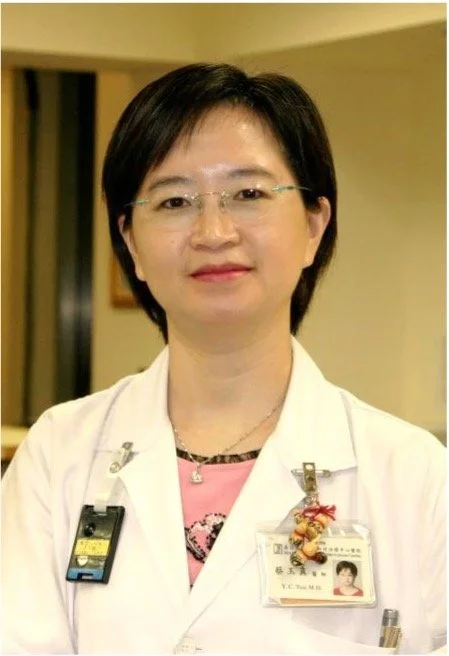
Author: Head & Neck and Nasopharyngeal Cancer Multidisciplinary Team, Dr. Yu-Chen Tsai
Dr. Tsai Yu-Chen currently serves as the head of the Radio-Oncology Department at KFSYSCC. As an attending physician specialized in radiation oncology, her expertise extends to the radiotherapeutic treatment of head, neck, nasopharyngeal, lung, esophageal, and breast tumors. Dr. Tsai graduated from the College of Medicine, National Taiwan University. In 1990, she started her journey as a resident physician in Internal Medicine at National Taiwan University Hospital. Since 1992, she has been serving at the KFSYSCC, where she became a senior resident in the Department of Radiation Oncology at Duke University in the United States in 1995, and an adjunct assistant professor in the same department in 2001. Dr. Tsai participates in the hospital's multidisciplinary integrated diagnosis and treatment teams for breast, lung, esophageal, head and neck, and nasopharyngeal cancers.
I Hope to Always Maintain Passion for Serving Patients
Over the past 30 years, KFSYSCC has established itself as a leading healthcare institution, and I have had the privilege to spend 28 years of my career growing and learning in this environment. I am deeply thankful to my mentors, colleagues, and patients for their significant roles in my journey. I would like to illustrate my gratitude by sharing a patient's story.
Our patient, a 40-year-old designer, who was also actively participating in a direct sales team that aimed to "help people lead better lives", was diagnosed with stage IVa nasopharyngeal carcinoma due to symptoms of nosebleeds and headaches. Despite an initial tendency to make light of his situation, he eventually confronted his disease with remarkable bravery.
His treatment at KFSYSCC consisted of simultaneous radiation and chemotherapy, followed by further chemotherapy, and then a period of minimal chemotherapy over six months. During his treatment, a nasogastric tube was used to ensure proper nutrition. He had to navigate a challenging journey of healing with a survival probability of just 60%. However, encouragement from Dr. Chen Xin Xuan helped him to persevere. “60% is just a statistical number; for you, it's either 100% or 0%”. He eventually made a gradual recovery, took up dancing, cycling, spiritual courses, and shared his experience on living a sustainable lifestyle.
Despite rigorous efforts, post-treatment MRI scans revealed residual shadows from the tumor, raising concerns about potential regrowth. However, ten years later, the patient not only remains healthy but also appears more youthful and energetic. He attributes this to the teachings of Thich Nhat Hanh’s book — The Art of Mindful Living, which has also inspired me to approach life with tranquility and resilience. Now, I read Thich Nhat Hanh's books daily to cleanse my soul and face the various challenges and trials in life with calmness and composure. Ten years ago, we stood by him during his tough times, and now he accompanies us in appreciating the beauty of life, sharing spiritual cultivation experiences, admiring nature's miracles, and happily embracing each day. Working at KFSYSCC is fulfilling because we truly adhere to the principle of prioritizing the welfare of patients. There's no pressure for performance, no need to compete for patients, and no need to promote self-funded examinations or treatments. Treatments that we would not use for ourselves, we would not recommend to our patients. In a fearless, clean, and warm environment, we can provide the best care to our patients, harnessing everyone's potential and growing from our own contributions.
My gratitude extends to Professor Andrew T. Huang, the President/CEO of KFSYSCC. His relentless dedication over the past 30 years to holistic cancer patient care, medical education, and opposition to irrational medical practices has significantly contributed to the growth of our institution. His support has greatly aided the Department of Radiation Oncology, facilitating us with advanced equipment through his fundraising efforts. These include the most advanced linear accelerators and other relevant equipment, ensuring that our treatment approaches remain at the forefront of technological advancements. I once said, "A good chef doesn't boast about his tools," so even though we possess high-end equipment, we refrain from bragging about it. It is essential for us to invest greater care and diligence to justify the use of such equipment.
In the 1990s, radiation therapy was the primary treatment for nasopharyngeal cancer in Taiwan. Professor Huang introduced combined chemoradio-therapy treatment protocol for head and neck cancer patients that he learned at Duke University, thus improving the cure rates for these patients. This protocol successfully improved the cure rates for nasopharyngeal cancer patients in Taiwan and gradually influenced the treatment approaches of other hospitals in Taiwan.
The Department of Radiation Oncology at KFSYSCC, initially established with assistance from Duke University, has experienced remarkable growth under the guidance of our enthusiastic director, Dr. Jer Min Jian.
Back in the 1990s, we started using cutting-edge Varian linear accelerators to move our treatment plans from 2D to 3D. By August 2003, we had incorporated intensity-modulated radiation therapy into our practice at KFSYSCC for treating nasopharyngeal cancer. Since then, we have been continuously improving our methods, greatly enhancing patients' quality of life by significantly reducing radiation therapy side effects. Our department currently has four advanced remote linear accelerators, all equipped for intensity-modulated radiation therapy. hree of these machines have Image Guided Radiation Therapy (IGRT) capabilities, and two of them possess Stereotactic Body Radiation Therapy (SBRT) and Respiratory Gating Radiation Therapy functionalities. We also have two CT simulation localization machines. Our department completed the digitization of medical records in 2015 and finished scanning all old records by 2016, officially stepping into the era of paperless record keeping.
In addition to state-of-the-art equipment and top-notch radiation therapy, we also focus on individualized treatment processes. We create custom-made pillows and mesh masks to fit each patient's head shape, ensuring a stationary head and neck for accurate targeting during the seven-week radiation therapy. In the CT room, we first carry out CT imaging and then transfer these images to a computer for treatment planning. Here, physicians incorporate original diagnostic head and neck MRI images and positron emission tomography (PET) images to define the tumor size and any potentially affected lymph regions. Once the treatment plan is complete, we verify its accuracy before initiating radiation therapy. We also take weekly verification images during the therapy to maintain the correct treatment position and adjust the plan if the tumor changes position or size.
The efficient treatment process is a collaborative effort involving our radiation therapy team. Radiation oncologists are tasked with comprehensively understanding a patient's condition, engaging with the medical team, determining the timing of radiation therapy in a patient's treatment cycle, planning the therapy, setting the scope and dose of radiation, and overseeing patient care during and after treatment, which includes assessing the effectiveness of the treatment and tracking the patient's condition post-treatment. Our radiation oncology nurses assist patients by addressing their concerns and fears, managing side effects, providing wound care, intravenous injections, scheduling necessary outpatient visits and tests, supporting patients throughout the treatment period, and managing potential side effects.
Radiation therapists operate the precise positioning and treatment equipment, assist patients with simulation imaging positioning, create accurate fixation molds for maintaining the tumor's consistent position during daily treatment, and ensure that treatments are correctly implemented each day. They also manage daily treatment schedules, assist patients in rescheduling when necessary, and answer questions about the radiation therapy process. Their responsibilities also extend to developing new fixation devices for precision and patient comfort. Medical physicists are responsible for calibrating, testing, and quality controlling radiation therapy doses, radiation protection, and shielding design, ensuring the reliability and accuracy of all treatment equipment, and developing new techniques and training programs. At the same time, we assist radiation oncologists in developing computerized treatment plans by inputting treatment data into our system. This helps calculate the distribution of radiation doses received by the tumor and surrounding healthy tissues.
Our department boasts a specialized equipment maintenance team, which includes radiation oncology specialists, medical physicists, and radiological technologists. This team oversees the upkeep of our existing CT scanners, linear accelerators, treatment planning computers, and integrated network systems. They also evaluate the pros and cons of prospective new machines, providing critical information to our purchasing staff. We also have a dedicated patient education team composed of physicians, nurses, radiation therapists, and physicists.
This team is responsible for producing educational materials such as slides, manuals, and pamphlets to help reduce patient anxiety and ensure clear understanding of the treatment process. By repeatedly explaining the treatment details, we help prevent avoidable side effects caused by misunderstandings. This educational content is available on our department's Facebook and YouTube channels.
Lastly, I would like to express my sincere gratitude to Dr. Skye Cheng, the former head of the Radiation Oncology Department. Dr. Cheng initiated a nasopharyngeal carcinoma database, established a clinical research lab, and guided us in determining the best treatment for nasopharyngeal carcinoma. Before the 1990s, radiation therapy was the standard treatment with a five-year survival rate of 30% to 50%. In 1998, a large-scale North American study (Intergroup Study) found that concurrent radiation and chemotherapy significantly improved survival rates (from 47% to 78% over three years). Unfortunately these findings were not widely accepted in Asia, particularly in Taiwan, Hong Kong, and Singapore. However, since the establishment of KFSYSCC, our hospital has always prioritized research on combined radiation and chemotherapy for nasopharyngeal carcinoma.
Our treatment process involves simultaneous radiation and chemotherapy, followed by adjuvant chemotherapy after radiation. This has resulted in a five-year survival rate of 84% at our hospital, approximately 20% higher than other studies reported in authoritative peer-reviewed radiation therapy journals. Recently, we have tailored the intensity and frequency of chemotherapy to match intensity-modulated radiation therapy (IMRT). For Stage II or III (high-risk group) patients without risk factors, we have eliminated post-radiation adjuvant chemotherapy. or patients in Stage II with risk factors or in Stage III (high-risk group), we have retained adjuvant chemotherapy after radiation. Stage IV patients (high-risk group) require a longer course of chemotherapy to reduce the risk of distant metastases.
With the combination of chemotherapy and IMRT, we've improved nasopharyngeal carcinoma cure rates and decreased radiation therapy side effects. IMRT is particularly beneficial for tumors of irregular shapes or those near radiation-sensitive organs where traditional radiation therapy may not be as effective. Since August 2003, we have used IMRT for nasopharyngeal carcinoma with three primary benefits: reduced radiation doses to the base of the tongue, preservation of the salivary glands, and improved hearing.
KFSYSCC has achieved five-year survival rates for nasopharyngeal carcinoma from 1990 to 2016 as follows:
95.5% for Stage I, 93% for Stage II, 87% for Stage III, 71.6% for Stage IVA, 65.2% for Stage IVB, and 15.1% for Stage IVC. These results are a testament to our collective efforts, brave patients, thorough imaging examinations, meticulous treatment plans, and resilient medical team across various departments.
Lastly, I want to encourage myself. After 28 years of practice and dedication, I aspire to maintain my passion for serving patients and keep my spirit calm in the face of future challenges.


