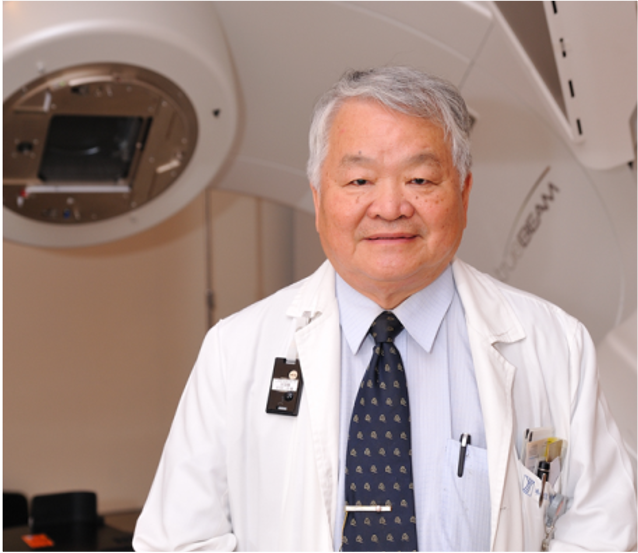

Author: Chief Medical Officer, Dr. Jer-Min Jian
Dr. Jian is the Chief Medical Officer and a Senior Attending Physician in the Department of Radiation Oncology at the KFSYSCC. His expertise lies in radiation therapy for head and neck cancer, nasopharyngeal cancer, breast cancer, and rectal cancer. He holds a Bachelor of Medicine from China Medical University and a Master's in Pathology from National Taiwan University.
In 1979, he served as an attending physician at the Cancer Treatment Center of Taipei Veterans General Hospital. In 1982, he became a Clinical Researcher in the Department of Radiation Oncology at Christie Hospital in Manchester, UK. By 1985, he had assumed the role of Director of the Radiation Therapy Department at the Cancer Treatment Center of Taipei Veterans General Hospital. He joined the KFSYSCC in 1990 and continues to serve there to this day.
In 2001, he took on a role as an Adjunct Associate Professor in the Department of Radiation Oncology at Duke University Medical Center in the United States. Dr. Jian is a part of the multidisciplinary diagnosis and treatment team for breast cancer, colorectal cancer, head and neck cancer, and nasopharyngeal cancer at KFSYSCC.
An Open Secret: Who is the Most Important Member of the Team?
KFSYSCC has been in operation for 30 years. Over this time, we've grown from a struggling start to becoming a highly reputed institution, trusted by many patients, their families, and the community at large. But what differentiates KFSYSCC?
Our principle has always been centered on the welfare of our patients. We prioritize the use of team-based approaches for different cancer types, delivering comprehensive information and treatment suggestions. This allows patients to make informed decisions and, following our collaborative resolution, ensures the smooth completion of treatments. Therefore, the most crucial member of our team is the 'patient.’
Our team includes specialists from surgery, oncology, radiotherapy, pathology, and radiology, along with dietitians, social workers, and other supportive members. However, the most vital member is the patient. Their perspectives often influence our treatment approaches, leading to improved patient care. The success of cancer treatments depends largely on early diagnosis, accurate treatment, and the patient's determination, perseverance, patience, and family support.
Given the asymmetry in medical information, typical cancer treatment models involve the primary physician confirming the diagnosis, determining the stage, and offering treatment suggestions based on their expertise. Often, anxious patients consent to suggested treatments without seeking a second opinion or gaining a deep understanding of the treatment methods. Regret may surface later when patients understand their condition better. Hence, we recommend obtaining a 'second opinion' from another group of physicians before making major and challenging treatment decisions to avoid regrets.
For example, early-stage breast cancer treatment can involve total mastectomy or tumor excision with axillary lymph node dissection. Both methods yield similar five-year survival rates and local control rates. Some surgeons may suggest a simpler total mastectomy, but this would not preserve the breast. Other surgeons might perform intraoperative radiotherapy on the tumor site after initial breast cancer lesion excision, instead of postoperative four-week radiotherapy. However, the latter's radiation dosage distribution can be controlled, though it takes longer. These varying treatment approaches should be thoroughly discussed preoperatively. We do not suggest intraoperative radiotherapy due to the uneven dosage distribution leading to inferior local tumor control. For stage III breast cancer patients, total mastectomy with axillary lymphadenectomy was the previous standard treatment. But the newer concept involves preoperative chemotherapy to shrink the tumor, followed by total or partial mastectomy with radiation therapy. If the tumor shrinks after chemotherapy, making breast preservation possible, then partial excision with radiation therapy is the optimal choice. Given the diversity of treatments, advances in technology, and the invention of new chemotherapy drugs, treatment methods have changed significantly and flexibly. Patient preference has become a key determinant, considering local control rate, survival rate, and organ function preservation, all of which challenge the wisdom and ideas of doctors and patients.
Team-based healthcare comprises members from different specialties, each contributing their knowledge, learning from others, and striving for patient organ preservation and functionality. Together, we determine the treatment method and sequence based on the patient's best interest, leading to the best treatment outcomes. Since its establishment, KFSYSCC (formerly Sun Yat-sen Cancer Center Hospital), under the leadership of President/CEO Huang, has formed various teams. Each team involves different members in patient treatment decisions, discussing team decisions with patients. Patients can express their thoughts and needs, which we duly consider, allowing them an active role in treatment decisions. Eventually, a consensus is reached, rather than a unilateral decision made by the physician. This prevents patients from becoming disadvantaged due to unequal medical knowledge.
We emphasize that the patient is the most important member of the cancer treatment team, involving them in treatment decisions. This might seem peculiar, but it has been our approach since the inception of KFSYSCC. We discuss the team's decision in detail with the patient, letting them and their families choose the best treatment method. For instance, 30 years ago, most surgeons in Taiwan did not believe in breast conservation for stage I and II breast cancer patients. As a result, most patients underwent total mastectomy. However, research from the United States in the 1980s found that the outcomes of breast-conserving surgery followed by radiotherapy for early-stage breast cancer patients were similar to total mastectomy in terms of five-year survival rates and local control rates. Additionally, breast conservation maintains the patient's feminine beauty. Therefore, they suggested prioritizing informing patients about breast conservation surgery options to avoid potential lawsuits. When we proposed breast conservation surgery to our patients, many were skeptical, questioning if leaving the breast would lead to tumor regrowth. We explained that this was now the standard treatment abroad, and gradually, patients became more accepting of breast-conserving surgery.
Statistical data from KFSYSCC demonstrates a yearly increase in the percentage of stage I and II patients undergoing breast-conserving surgery. The rate increased from 32% in 2000 to 55% in 2014. Survival and local control rates were excellent, and the added advantage is that patients could keep their breasts, preserving a key feature of female identity. Therefore, apart from survival rates, patients often also consider the impact on their future quality of life when discussing treatment options.
KFSYSCC does not emphasize the use of high specification treatment equipment or expensive drugs, but instead focuses on providing the most appropriate treatment options, considering patients' economic circumstances to achieve equivalent treatment outcomes. The choice of chemotherapy drugs is determined based on their effectiveness, with a preference for using original manufacturer drugs. The aim is to provide precise treatment with minimal side effects, and decisions on the correct and appropriate treatment are made based on each patient's health condition. Patient participation in treatment decision-making, coupled with a good doctor-patient relationship, results in a high treatment compliance rate. The hospital's treatment outcomes have been rated highly in national statistics. Several well-known personalities in Taiwan have been treated at KFSYSCC and are still active in the political scene.
Nancy Reagan, the wife of President Reagan, was diagnosed with breast cancer in 1987 at the age of 66. Although she understood that the efficacy of breast-conserving surgery was the same as a mastectomy, she chose to undergo a full mastectomy due to her age, and also because the six weeks of postoperative radiotherapy would interfere with her public activities with her husband. She lived until the age of 94 and died of heart disease.
Famous actress Angelina Jolie, whose mother suffered from breast cancer for ten years before her death, underwent a preventive double mastectomy and reconstruction in 2016 after learning she carried the BRCA-1 gene, which gave her an 87% lifetime risk of developing breast cancer and a 50% risk of developing ovarian cancer. She had her ovaries removed two years later.
Although some people disapproved of her decision, deeming it excessive, she had every right to make her own choices. Therefore, providing patients with sufficient medical information and allowing them to participate in medical decision-making is the current mainstream approach.
During the medical process, we have formed friendships with patients and their families through positive interactions. While "treating patients as family" might be a lofty ideal, "treating patients as friends" is the real ethos we practice. Often, in our interactions with patients, there are ‘open secrets.' One patient, after a year of surgery, chemotherapy, and radiation, would always begin her check-ups by sitting in the clinic chair and saying, "I feel so relaxed, as comfortable as if I were at home." The fact that patients can feel stress-free and safe when they come to the hospital is very gratifying.
Another patient, after long discussions, finally decided on her treatment direction. She told me she had been so nervous that morning that she hadn't eaten. I pulled a 75% cocoa chocolate bar out of my pocket and gave it to her. She was delighted and thanked me. Two years later, after she completed her treatment, she brought me a box of 75% cocoa chocolate at one of her check-ups, saying she had always remembered that moment, even showing me a photo she had taken with her phone at the time, specifying that it was "the same brand." This heartfelt feedback was truly touching.
Typically, patients with head and neck cancers need about seven weeks of radiation and chemotherapy. Due to difficulties in swallowing and changes in taste causing loss of appetite, they often lose weight. Thus, before starting radiation therapy, I often remind each patient to remember the mantra, "Act foolish, eat plenty," which means to avoid overthinking and try to eat as much nutritious food as possible to maintain their weight. Adequate nutrition speeds up tissue recovery. During the clinic visit before radiation treatment, I always shake hands with patients, encouraging them and hoping they undergo the treatment well. Three months after one patient completed her treatment, the side effects of radiation had lessened, her taste had returned, her body was gradually recovering, the MRI showed everything was back to normal, the tumor had completely disappeared, and she was preparing to go back to work. After her check-up, she asked to shake my hand, saying, "Thank you, doctor, for the encouraging handshake before the treatment. It gave me a lot of confidence to overcome the discomfort of the treatment. I have strived to adhere to the mantra, although I couldn't achieve it entirely. But I have already reached the three main goals I had before treatment: 'Cure the disease, lose weight, and resurface local skin.' " These are the warm "little secrets" left in the good interaction between doctor and patient.