
Colorectal Cancer Outcomes at KFSYSCC
Between 2015-2019, the five-year survival rate for colorectal cancer at KFSYSCC was 66.5% vs 56.7% for other hospitals in Taiwan.
Basic Information and Distribution of 3,018 Colon Cancer Patients at KFSYSCC from 1990-2019
| Total | 1990-1994 | 1995-1999 | 2000-2004 | 2005-2009 | 2010-2014 | 2015-2019 | |
|---|---|---|---|---|---|---|---|
| n | 3,018 | 46 (2%) | 206 (7%) | 508 (17%) | 685 (23%) | 830 (28%) | 743 (25%) |
| Gender (%) | |||||||
| Male | 1,526 (51%) | 32 (70%) | 113 (55%) | 251 (49%) | 343 (50%) | 441 (53%) | 346 (47%) |
| Female | 1,492 (49%) | 14 (30%) | 93 (45%) | 257 (51%) | 342 (50%) | 389 (47%) | 397 (53%) |
| Age | |||||||
| Mean/Median | 59/60 | 61/64 | 62/64 | 59/60 | 59/58 | 59/59 | 60/60 |
| Range | 17-93 | 31-87 | 20-90 | 19-93 | 17-92 | 19-93 | 24-93 |
| Q1-Q3 | 51-69 | 49-71 | 54-70 | 49-69 | 51-68 | 51-68 | 51-68 |
| Stage (%) | |||||||
| 0 | 134 (4%) | 1 (2%) | 3 (1%) | 17 (3%) | 25 (4%) | 41 (5%) | 47 (6%) |
| I | 356 (12%) | 2 (4%) | 15 (7%) | 51 (10%) | 87 (13%) | 111 (13%) | 90 (12%) |
| II | 677 (22%) | 5 (11%) | 43 (21%) | 108 (21%) | 158 (23%) | 189 (23%) | 174 (23%) |
| III | 872 (29%) | 14 (30%) | 38 (18%) | 148 (29%) | 213 (31%) | 255 (31%) | 204 (27%) |
| IV | 832 (28%) | 13 (28%) | 35 (17%) | 140 (28%) | 199 (29%) | 231 (28%) | 214 (29%) |
| Unknown | 147 (5%) | 11 (24%) | 72 (35%) | 44 (9%) | 3 (0.4%) | 3 (0.4%) | 14 (2%) |
Based on KFSYSCC's cancer registry from 1990 to 2019, there were 3,018 analytic colon cancer cases, with 1,526 males (51%) and 1,492 females (49%). The average and median ages were 59 and 60 years old, respectively; the youngest patient was 17 years old, and the oldest was 93 years old; the interquartile range (Q1-Q3) was 51-69. By stage, there were 134 stage 0 colon cancer patients (4%), 356 stage I patients (12%), 677 stage II patients (22%), 872 stage III patients (29%), and 832 stage IV patients (28%). The table below presents the basic patient information and stage distribution, categorized by the year of diagnosis.
Basic Information and Distribution of 2,403 Rectal Cancer Patients at KFSYSCC from 1990-2019
| Total | 1990-1994 | 1995-1999 | 2000-2004 | 2005-2009 | 2010-2014 | 2015-2019 | |
|---|---|---|---|---|---|---|---|
| n | 2,403 | 42 (2%) | 223 (9%) | 519 (22%) | 526 (22%) | 603 (25%) | 490 (20%) |
| Gender (%) | |||||||
| Male | 1,420 (59%) | 22 (52%) | 125 (56%) | 318 (61%) | 305 (58%) | 376 (62%) | 274 (56%) |
| Female | 983 (41%) | 20 (48%) | 98 (44%) | 201 (39%) | 221 (42%) | 227 (38%) | 216 (44%) |
| Age | |||||||
| Mean/Median | 59/59 | 62/64 | 59/60 | 58/59 | 59/59 | 59/59 | 58/58 |
| Range | 21-90 | 37-80 | 31-90 | 23-90 | 21-90 | 21-90 | 29-90 |
| Q1-Q3 | 50-68 | 55-70 | 49-68 | 49-68 | 50-68 | 50-68 | 50-67 |
| Stage (%) | |||||||
| 0 | 101 (4%) | 5 (12%) | 8 (4%) | 13 (3%) | 17 (3%) | 37 (6%) | 21 (4%) |
| I | 359 (15%) | 4 (10%) | 38 (17%) | 68 (13%) | 82 (16%) | 92 (15%) | 75 (15%) |
| II | 348 (14%) | 5 (12%) | 38 (17%) | 90 (17%) | 80 (15%) | 78 (13%) | 57 (12%) |
| III | 986 (41%) | 12 (29%) | 38 (17%) | 182 (35%) | 238 (45%) | 288 (48%) | 228 (47%) |
| IV | 418 (17%) | 3 (7%) | 19 (9%) | 89 (17%) | 104 (20%) | 101 (17%) | 102 (21%) |
| Unknown | 191 (8%) | 13 (31%) | 82 (37%) | 77 (15%) | 5 (1%) | 7 (1%) | 7 (1%) |
Based on KFSYSCC's cancer registry from 1990 to 2019, there were 2,403 analytic rectal cancer cases, with 1,420 males (59%) and 983 females (41%). The average and median ages were 59 and 59 years old, respectively; the youngest patient was 21 years old, and the oldest was 90 years old; the interquartile range (Q1-Q3) was 50-68. By stage, there were 101 stage 0 rectal cancer patients (4%), 359 stage I patients (15%), 348 stage II patients (14%), 986 stage III patients (41%), and 418 stage IV patients (17%). The basic information and stage distribution of all rectal cancer patients, sorted by the year of diagnosis, are presented in the table below.
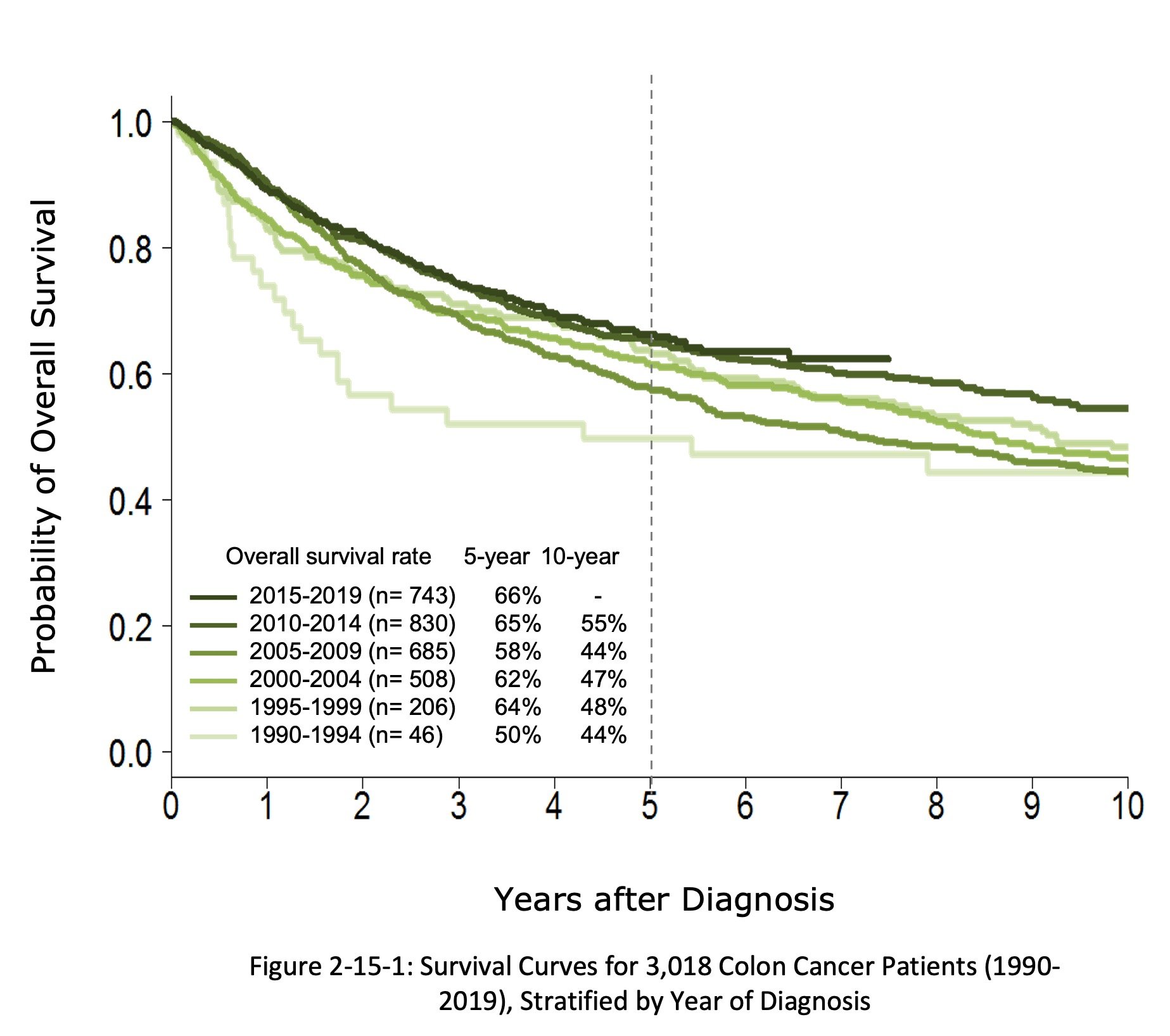
Survival Curves for 3,018 Colon Cancer Patients (1990-2019), Stratified by Year of Diagnosis
From 1990 to 2019, the chart illustrates the five-year observed survival rates for 3,018 colon cancer patients at KFSYSCC, stratified by the year of diagnosis. The graph shows the five-year survival rate for colon cancer increased from 50% in 1990-1994 to 66% in 2015-2019, while the ten-year survival rate rose from 44% in 1990-1994 to 55% in 2010-2014.
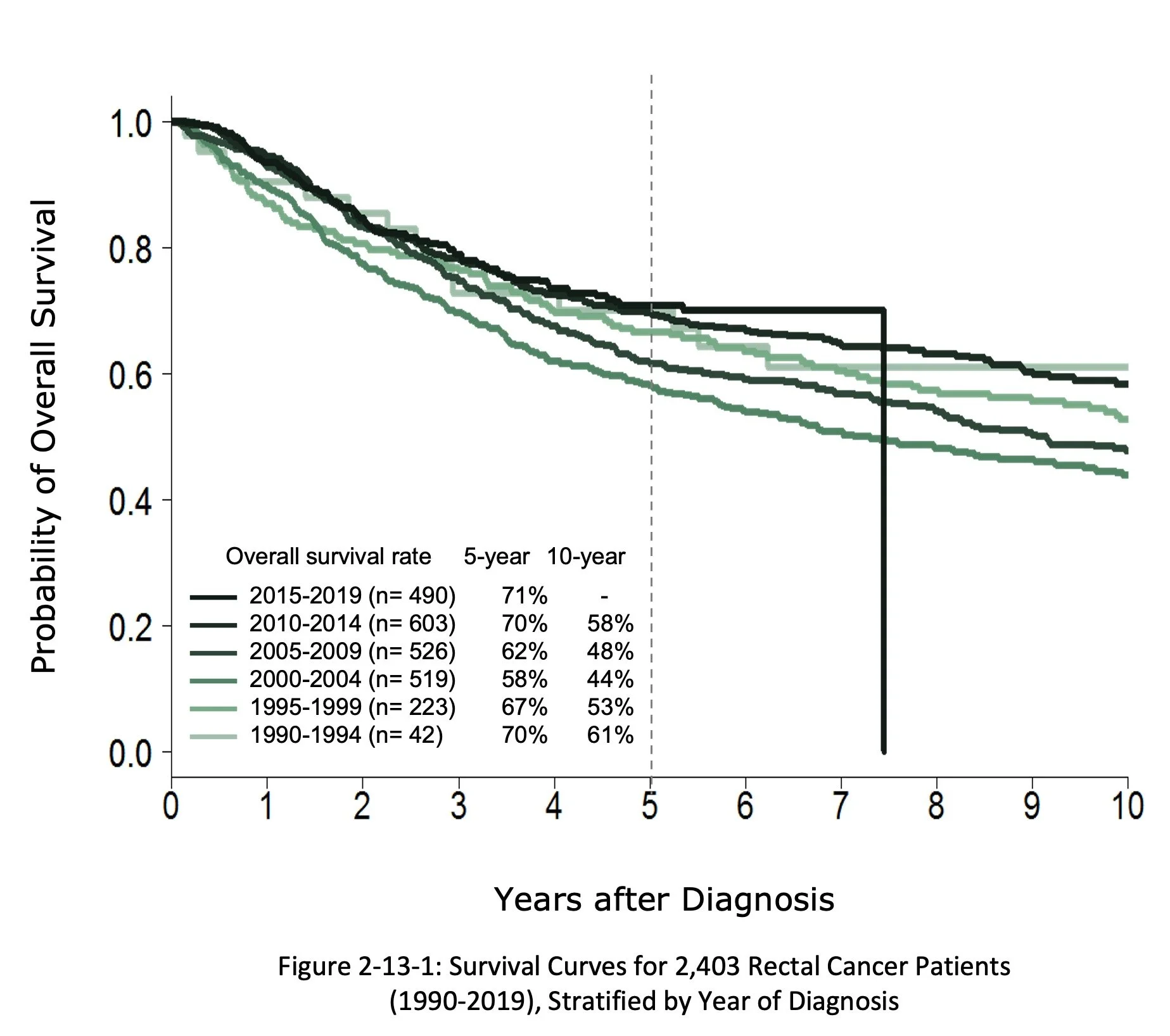
Survival Curves for 2,403 Rectal Cancer Patients (1990-2019), Stratified by Year of Diagnosis
From 1990 to 2019, the chart illustrates the five-year observed survival rates for 2,403 rectal cancer patients at KFSYSCC, stratified by the year of diagnosis. The graph shows the five-year survival rate for rectal cancer increased from 70% in 1990-1994 to 71% in 2015-2019, while the ten-year survival rate decreased from 61% in 1990-1994 to 58% in 2010-2014.
Treatment Methods and Stages for 743 Colon Cancer Patients at KFSYSCC (2015-2019)
| Treatment Type | Total | Stage 0 | Stage I | Stage II | Stage III | Stage IV | Unknown |
|---|---|---|---|---|---|---|---|
| Total | 743 | 47 | 90 | 174 | 204 | 214 | 14 |
| Surgical Treatment | 677 (91%) | 46 (98%) | 90 (100%) | 174 (100%) | 201 (99%) | 153 (72%) | 13 (93%) |
| Radiation Therapy | 17 (2%) | 1 (2%) | 1 (1%) | 3 (2%) | 4 (2%) | 8 (4%) | 0 (0%) |
| Chemotherapy | 434 (58%) | 0 (0%) | 1 (1%) | 63 (36%) | 175 (86%) | 195 (91%) | 0 (0%) |
| Targeted Therapy | 124 (17%) | 0 (0%) | 0 (0%) | 0 (0%) | 3 (1%) | 121 (57%) | 0 (0%) |
| Palliative Care | 70 (9%) | 0 (0%) | 0 (0%) | 1 (1%) | 3 (1%) | 65 (30%) | 1 (7%) |
| No Record of Initial Treatment Reported | 1 (0.1%) | 1 (2%) | 0 (0%) | 0 (0%) | 0 (0%) | 0 (0%) | 0 (0%) |
Between 2015 and 2019, there were a total of 743 analytic colon cancer cases, including 47 patients in stage 0, 90 in stage I, 174 in stage II, 204 in stage III, and 214 in stage IV. In terms of treatment methods, 677 patients (91%) underwent surgical treatment, 17 (2%) received radiation therapy, 434 (58%) underwent chemotherapy, 124 (17%) received targeted therapy, 70 (9%) underwent palliative care, and 1 (0.1%) had no record of initial treatment reported.
Treatment Methods and Stages for 490 Rectal Cancer Patients at KFSYSCC (2015-2019)
| Treatment Type | Total | Stage 0 | Stage I | Stage II | Stage III | Stage IV | Unknown |
|---|---|---|---|---|---|---|---|
| Total | 490 | 21 | 75 | 57 | 228 | 102 | 7 |
| Surgical Treatment | 435 (89%) | 21 (100%) | 72 (96%) | 56 (98%) | 214 (94%) | 65 (64%) | 7 (100%) |
| Radiation Therapy | 214 (44%) | 0 (0%) | 7 (9%) | 15 (26%) | 159 (70%) | 33 (32%) | 0 (0%) |
| Chemotherapy | 324 (66%) | 0 (0%) | 7 (9%) | 25 (44%) | 197 (86%) | 95 (93%) | 0 (0%) |
| Targeted Therapy | 61 (12%) | 0 (0%) | 1 (1%) | 0 (0%) | 5 (2%) | 55 (54%) | 0 (0%) |
| Hormone Therapy | 1 (0.2%) | 0 (0%) | 0 (0%) | 0 (0%) | 0 (0%) | 1 (1%) | 0 (0%) |
| Palliative Care | 27 (6%) | 0 (0%) | 0 (0%) | 0 (0%) | 0 (0%) | 27 (26%) | 0 (0%) |
| No Record of Initial Treatment Reported | 1 (0.2%) | 0 (0%) | 1 (1%) | 0 (0%) | 0 (0%) | 0 (0%) | 0 (0%) |
Between 2015 and 2019, there were a total of 490 analytic rectal cancer cases, including 21 patients in stage 0, 75 in stage I, 57 in stage II, 228 in stage III, and 102 in stage IV. In terms of treatment methods, 435 patients (89%) underwent surgical treatment, 214 (44%) received radiation therapy, 324 (66%) underwent chemotherapy, 61 (12%) received targeted therapy, 1 (0.2%) received hormone therapy, 27 (6%) underwent palliative care, and 1 (0.2%) had no record of initial treatment reported.

Five-Year Survival Rates of 743 Colon Cancer Patients by Stage (2015-2019)
KFSYSCC’s 2015-2019 five-year observed survival rates for 743 colon cancer patients, stratified by stage, are presented in the following chart. As shown in the graph, the five-year survival rate is 96% for stage 0, 92% for stage 1, 91% for stage 2, 80% for stage 3, and 19% for stage 4.
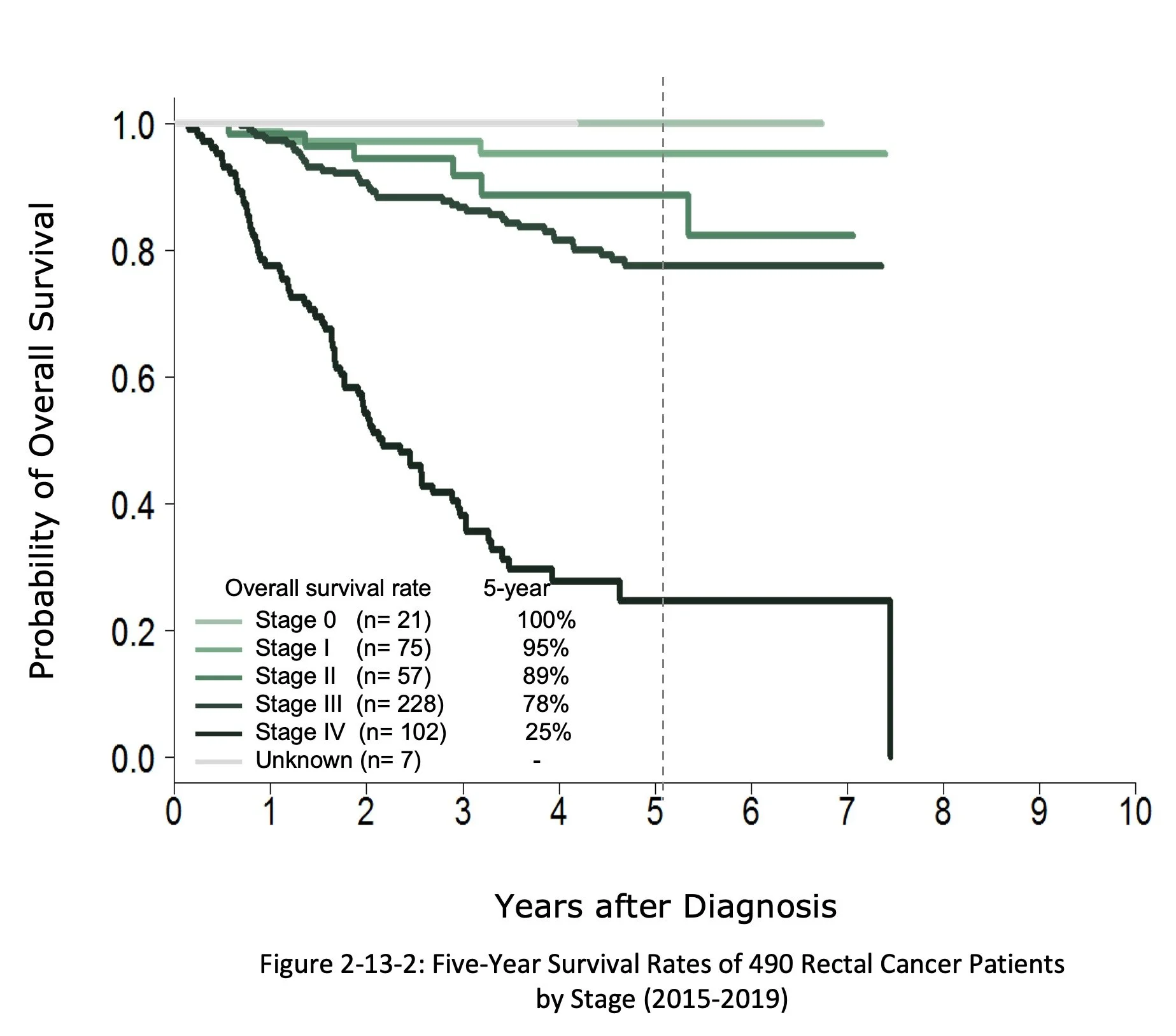
Five-Year Survival Rates of 490 Rectal Cancer Patients by Stage (2015-2019)
KFSYSCC’s 2015-2019 five-year observed survival rates for 490 rectal cancer patients, stratified by stage, are presented in the following chart. As shown in the graph, the five-year survival rate is 100% for stage 0, 95% for stage 1, 89% for stage 2, 78% for stage 3, and 25% for stage 4.