
What Struck First: Cervical Cancer or Endometrial Cancer?

The Woman Behind the Chart
She is 53, a married homemaker with three grown children, financially comfortable, never a smoker or drinker, no betel-nut or drug use, and, crucially, she has never once had a Pap smear.
Menstruation began at fifteen and stayed clock-work regular until 2023. The final period that year was followed by intermittent brown discharge, a nuisance she blamed on “hormones.” During January and February 2024 the staining stopped, then two months later a few red drops returned; she dismissed them as the normal chaos of menopause. By October the bleeding was bright red, noticeably heavier after she ate sesame-oil chicken and other traditional dishes.
Her obstetric history is complex: nine pregnancies, three live births, six spontaneous miscarriages. She has been sexually inactive for a decade. Over the past two years dysmenorrhea has grown severe enough to require pain medication.
November 2024: An Exam She Couldn’t Ignore
Increasing bleeding finally drove her to the gynecology clinic. Pelvic examination revealed a friable cervical mass shedding tissue. A biopsy pointed to cervical cancer and she was referred to the gynecologic-oncology unit at Koo Foundation Sun Yat-Sen Cancer Center, where colposcopic biopsy confirmed squamous-cell carcinoma (SCC) of the cervix. High-risk HPV typing was positive for HPV-16 and HPV-40. Vaginal examination showed the tumor already extending into the vaginal canal, so magnetic-resonance imaging (MRI) and positron-emission tomography (PET) were ordered to complete staging.
Imaging Upsets the Premise
The pelvic MRI dated November 19, 2024 painted a different picture: an endometrial carcinoma invading downward into the cervix and a nodular lesion in the left pelvis, yet still no disease in lung or liver. PET suggested either an enlarged left-pelvic lymph node or metastatic spread to the left ovary. An endometrial biopsy returned endometrioid adenocarcinoma; mismatch-repair proteins were intact and p53 remained wild type.
The team therefore confronted two primary malignancies: a biopsy-proven cervical SCC and a separate endometrial carcinoma that might already have reached the ovary or pelvic lymph nodes.
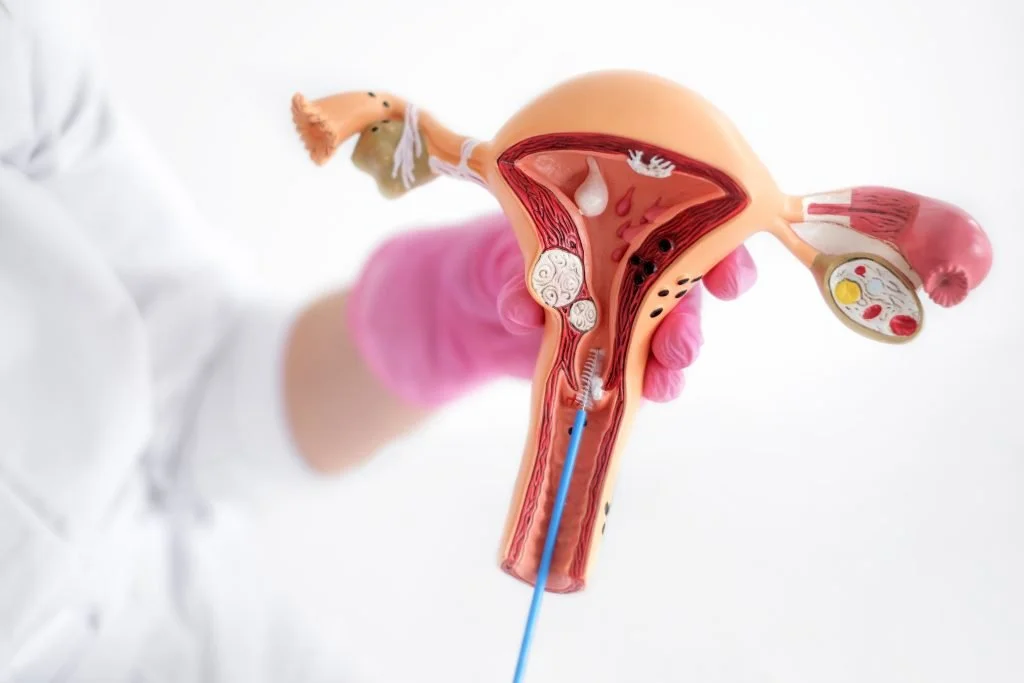
One Operation, Two Cancers
She was admitted for a modified radical hysterectomy, bilateral removal of tubes and ovaries, pelvic and para-aortic lymph-node dissection, plus excision of tumor deposits on the rectal wall and within the pelvic cavity.
Post-operative pathology split the verdict:
Cervix: squamous-cell carcinoma, FIGO stage I, pT1b1 (tumor ≤ 2 cm), confined to the cervix, no regional nodal disease.
Endometrium: endometrioid adenocarcinoma, FIGO stage IIIC2 (metastasis to para-aortic lymph nodes).
Thus a “slow-moving” cervical cancer appeared early, while the endometrial cancer had already leapt forward; which surfaced first in time remains unknowable, but either way the coexistence proved dangerous.
Why Any Bleeding After Mid-Life Demands Attention
Cervical cancer can smolder for years, yet low stage does not guarantee it arrived last. Likewise, an advanced endometrial carcinoma is not automatically the first aggressor. For every peri- or post-menopausal woman, any unexplained bleeding, no matter how little, deserves immediate medical evaluation. Delay lets the disease choose its own timetable, and that timetable is rarely merciful.

Essential Knowledge Corner
Pap smears save lives. The test detects precancerous change long before invasive cervical cancer takes hold; treatment at that stage usually involves only a cone biopsy or localized surgery. Once the disease reaches an advanced or metastatic setting, chemotherapy offers limited response rates, significant toxicity (immunosuppression, fatigue, nausea, vomiting), and only modest extensions in overall survival.
Benefits of regular screening include early cure, avoidance of disfiguring combined chemoradiation, lower healthcare costs, and heightened awareness of reproductive health.
Social and sexual context matters. High-risk HPV spreads primarily through sexual contact. Early sexual debut, multiple partners, or a partner with multiple partners all elevate risk; women in such categories benefit most from consistent screening. Cultural stigma around sexual health can deter attendance, so education must emphasize that a Pap test safeguards every woman’s future, irrespective of current sexual activity. Even women long past childbearing, or years removed from their last intercourse, remain at risk if they have ever been sexually active.
For women who have never engaged in sexual activity, the risk of HPV-driven disease is extremely low; routine Pap testing is not required unless circumstances change. For everyone else the guiding rule is simple: if bleeding is not expected, however light, see a physician at once.