Spotting Hidden Warning Signs of Decline: How ICOPE Helps Protect Older Adults’ Health
Interviews: Min-Juan Chang (Team Lead, Center for Healthy Aging), Chia-Yu Hsieh (Registered Nurse), Ying-Chen Huang (Program Manager)
Written by: Jo-Yu Lin
Photography: Ying-Chen Huang
Have you noticed an older family member walking more slowly than before? Maybe their memory seems worse, they’re eating less, they often feel down, or they just don’t feel motivated to do everyday activities. Changes like these can look minor, but they are often early signs that physical and emotional functioning may be quietly declining. Many families do not realize how serious things have become until an older adult falls, dementia worsens, or long-term care becomes necessary, and by then the best window for early prevention and intervention may have already passed.
How Can You Tell When an Older Adult’s Health Is Sending Warning Signals?
Aging does not automatically mean disability. When changes are noticed early and addressed early, many older adults can maintain a good quality of life and stay independent. The real challenge is this: how do we detect early warning signs at the stage when someone “still seems fine”? This is exactly where the value of ICOPE, the Integrated Care for Older People assessment tool, comes in.
Through simple questions and observation, ICOPE can help identify early signs of decline in areas such as cognition, mobility, mood, senses, and nutrition while an older adult is still largely able to care for themselves. This creates a foundation for preventing disability and slowing cognitive decline.
ICOPE is designed to be easy to use. It relies on a short questionnaire and a few simple, practical checks, and it does not require advanced medical equipment. That makes it suitable for community workers, healthcare organizations, and family caregivers. If something concerning is found, the next step can be timely medical evaluation or “re-ablement” support such as nutrition counseling, exercise programs, cognitive stimulation, and emotional support. The goal is to reduce the risk of disability and dementia and to improve overall well-being and quality of life.
Local Community Care: KFSYSCC’s ICOPE Outreach in Beitou
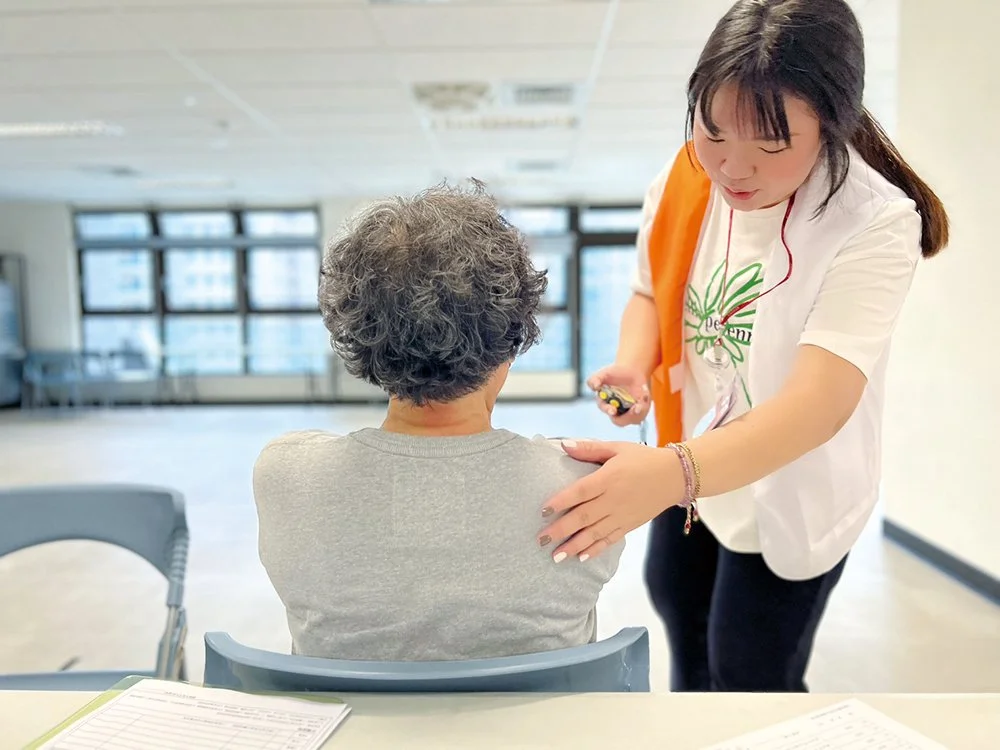
To make ICOPE more than a tool on paper and bring it into real life, Koo Foundation Sun Yat-Sen Cancer Center (KFSYSCC) has actively partnered with neighborhood and community offices across the Beitou area. These programs center on ICOPE-based functional assessments and combine them with practical, prevention-focused activities. The goal is not only to help older adults detect early functional decline, but also to increase participation through approaches that feel friendly, engaging, and interactive.
Registered Nurse Chia-Yu Hsieh shared a story from one outreach visit. The team was assessing an older woman’s health, and during conversation, Nurse Hsieh noticed a faint sadness on her face. The woman admitted that she sometimes felt depressed and had even experienced darker thoughts. Nurse Hsieh recognized the risk immediately and set the form aside to listen carefully to what the woman was carrying. The woman shared that she had once been afraid to go out and only tried joining community activities after friends encouraged her. Because she lived alone and her mood was low, the team provided mental health support resources and contact options. Nurse Hsieh shared that she felt grateful the outreach program made it possible to help her at that moment.
Team Lead Min-Juan Chang emphasized another key benefit: bringing ICOPE into the community allows the team to meet older adults who previously did not want to seek care or had not yet realized they needed regular checkups. She explained that conversations with healthcare professionals can help older adults move from hesitation to action, ease fears about dementia, and connect them with accurate information, motivation to seek care, and practical follow-up resources.
KFSYSCC’s Center for Healthy Aging has also designed a wide range of activities beyond ICOPE screening. These include a series of health promotion talks for older adults, such as education on sarcopenia (age-related muscle loss), as well as the Japanese “Square Stepping Exercise,” an activity designed to support cognitive function in older adults. The programs emphasize a positive cycle: keep moving, keep smiling, and keep living well. Since July of this year, the Center for Healthy Aging has worked deeply in Beitou District and has served nearly 100 older adults. Participation has been enthusiastic, and many older adults have shown remarkable energy on site. Through this kind of community-based effort, KFSYSCC is steadily putting its vision into practice: supporting healthy aging and helping communities thrive together, so older adults can receive care and support in familiar places where they feel safe.
What Is ICOPE?
Integrated Care for Older People (ICOPE) is a key healthy aging strategy developed by the World Health Organization (WHO) in response to global population aging. Its goal is to help people age in a healthier way, so that even as physical functions change, older adults can continue living with independence and dignity.
ICOPE focuses on screening six core areas of “intrinsic capacity,” the set of abilities that support daily functioning. These six areas include cognitive function, mobility, emotional well-being (such as depression), vision, hearing, and nutrition.